Glossary
What is a recipient allowlist for AI agents?
A recipient allowlist limits who an agent can pay to approved addresses. Why addresses must be compared canonically, and what an allowlist doesn't stop.
A recipient allowlist is a list of approved payees, such as wallet addresses, that a payment system checks before it lets an agent pay; payments to anyone not on the list are held or refused.
How does it work?
Spending limits cap how much an agent can pay; an allowlist caps who it can pay. That matters because the most damaging failures are about destination, not amount: a prompt-injected agent sending funds to an attacker, or a typo sending them to an address nobody controls. An allowlist turns 'any address' into 'one of these addresses'. It matters most where nothing else constrains the destination. An ERC-20 allowance, for example, limits how much a spender can move but not where it goes. The check has to compare addresses correctly. Ethereum-style addresses are hexadecimal, and ERC-55 adds a checksum by capitalising some letters based on a hash of the lowercase address. The same address can therefore be written in all lowercase or in checksummed mixed case, and both refer to the same account. A naive string comparison would treat them as different, refusing a legitimate payee or, in a deny-list, letting a blocked one through. Comparing a canonical form, such as lowercase after validating the format, avoids that. The checksum itself is still useful at entry time, because ERC-55 designed it so that a mistyped address will almost always fail the check.
In practice
Add payees from a trusted source, such as the invoice or the provider's own documentation, not from something the agent read on a web page. Check the checksum when you enter an address, and confirm the network as well as the address, since the same address string can exist on several chains. Keep the list short and review it: every entry is somewhere the agent can send money without asking. If a payee changes address, remove the old entry rather than adding a second.
What it does not mean
- An allowlist doesn't cap amounts. A payment to an approved address can still be too large; that's what per-payment and daily limits are for.
- Upper and lower case versions of an address are not different recipients. ERC-55 capitalisation is a checksum, not part of the identity.
- It doesn't verify that a payee is honest, only that it is one you chose.
- An address on the list for one network isn't automatically safe on another.
Where does Veyra fit?
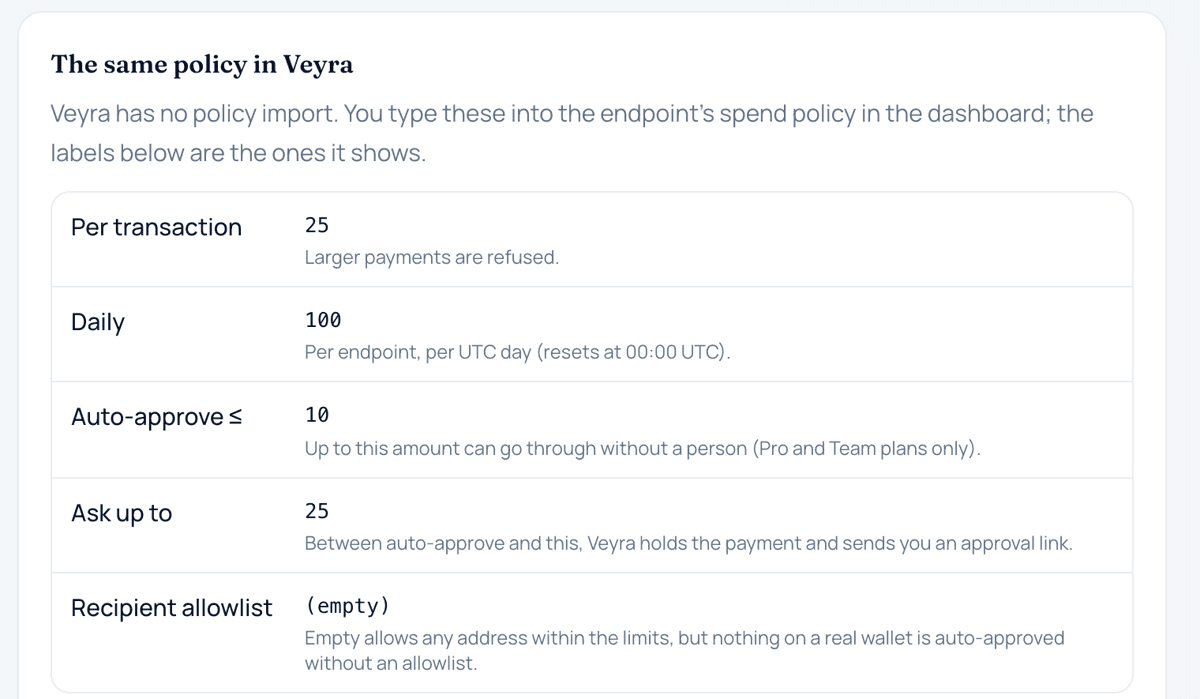
Each Veyra endpoint's policy can carry a recipient allowlist, checked server-side on every create_payment, with addresses compared in canonical form so case differences don't matter. An empty allowlist disables unattended auto-pay entirely: every payment then needs your approval, whatever its size. Payments to listed addresses still go through the per-payment, daily, auto-approve and ask limits.
Sources
Guides that use this term
- How to restrict who an AI agent can payA recipient allowlist limits where an agent's money can go, which amount caps can't. How to build one, match addresses safely and handle new payees.
- Can prompt injection make an AI agent spend money?Yes, if the agent has a payment tool and nothing outside the model checks it. How injected instructions reach a payment and which controls still hold.
- How to set spending limits for an AI agentPer-payment cap, daily cap, an auto-approve band and an ask band, enforced outside the model. How to choose each number and what happens at each edge.
This page explains how agent payments and the related technology work. It is not financial, investment, legal or tax advice. Protocols and provider features change; check the linked official sources before relying on a detail.