Glossary
What is a smart account (ERC-4337)?
A smart account is a wallet run by contract code, so it can enforce rules like spending caps. How ERC-4337 works and how agents get limited access.
A smart account is a blockchain account controlled by smart contract code rather than a single private key, so it can apply its own rules to every transaction; ERC-4337 is the Ethereum standard that supports them without changing the core protocol.
How does it work?
An ordinary externally owned account does whatever its private key signs. A smart account runs a validation function first, so it can require several signatures, restrict transactions to trusted addresses, let someone else pay gas or batch steps such as approve-and-pay into one action. ethereum.org describes these as the benefits of account abstraction. ERC-4337, a final standard, delivers it through a separate system that runs alongside Ethereum's own: users send UserOperations to an alternative mempool, bundlers package them and submit them to a singleton EntryPoint contract, and each account's validateUserOp checks the signature before execution. Optional paymasters can pay gas on the user's behalf, and factories deploy new accounts. EIP-7702 adds another route by letting existing externally owned accounts be controlled by contract code. For agents, the useful idea is delegating a slice of authority. Wallet vendors often call this session keys or spend permissions: a separate key the agent holds that the account will only honour within limits, such as an amount, a token, a set of contracts and an expiry. ERC-4337 doesn't define those rules itself; each account implementation does. ERC-7715, still a draft, proposes a standard wallet method for an app to request such scoped permissions, with expiry rules and allowances. x402's exact scheme lists ERC-7710 delegation as its option for smart accounts.
In practice
If you give an agent a session key, read what the account will actually enforce: which tokens, how much per period, which recipients or contracts, and when it expires. Check how to revoke it and test the revocation. Prefer limits enforced by the account's contract over limits that live only in the agent's code. Remember that a smart account is a contract: its safety depends on its code and any modules you install.
What it does not mean
- A smart account isn't a custodial account. You still control it, through keys and rules you set.
- Session key isn't a standard term with one meaning; each wallet defines what its keys can do.
- ERC-4337 doesn't by itself add spending limits. The account implementation does.
- A smart account on one chain isn't automatically deployed at the same address on another.
Where does Veyra fit?
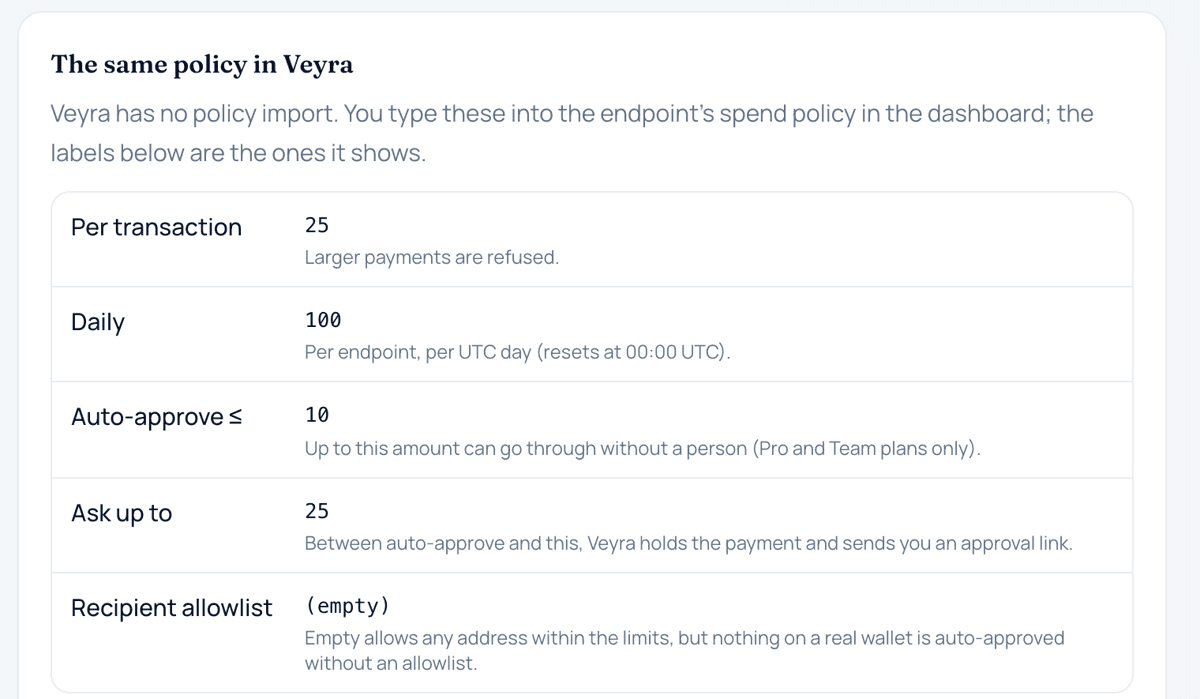
Veyra doesn't use session keys, ERC-4337 or spend permissions. It enforces its limits on its own server before any payment is made, and on paid plans pays from a capped ERC-20 allowance your wallet grants to its relayer; on the Free plan you sign every payment yourself. It never asks for a seed phrase or private key.
Sources
Guides that use this term
- What is an AI agent wallet?The four kinds of AI agent wallet: custodial balances, agent-held keys, smart accounts with spend permissions, and owner wallets behind a policy layer.
- Custodial vs non-custodial wallets for AI agentsWho holds the money and the keys when an AI agent pays: custodial balances, agent-held keys, and owner wallets with delegated limits compared.
- Should you give an AI agent a crypto private key?Why a private key in an agent's prompt, config or environment is full control of the wallet, and what to do instead to let it pay without one.
- How to set spending limits for an AI agentPer-payment cap, daily cap, an auto-approve band and an ask band, enforced outside the model. How to choose each number and what happens at each edge.
This page explains how agent payments and the related technology work. It is not financial, investment, legal or tax advice. Protocols and provider features change; check the linked official sources before relying on a detail.