Concepts and protocols
What is an AI agent wallet?
The four kinds of AI agent wallet: custodial balances, agent-held keys, smart accounts with spend permissions, and owner wallets behind a policy layer.
An AI agent wallet is any arrangement that lets an AI agent pay with crypto, usually stablecoins, on someone's behalf. It can be a balance a provider holds, a key the agent or its server controls, a smart account with limited spending permissions, or your own wallet with a policy layer deciding what the agent may request.
Why is this harder than it sounds?
The phrase covers very different set-ups. In some, the agent really has its own money and its own key. In others, the agent never holds anything and only asks for payments that something else approves. They look the same from the chat window, since the agent calls a tool and money moves, but they differ in who can move the funds, how much, to whom, and what happens if the agent is misled. An agent reads untrusted text all day, so the useful question isn't whether an agent has a wallet, but what an attacker could make that wallet do.
How do you do it?
- Custodial balance. A provider holds the funds and keeps a balance for the agent. You top it up; the agent spends from it under the provider's rules. Nothing on-chain is under your direct control, and you rely on the provider's controls and solvency.
- Agent-held or developer-held key. The agent, or the server running it, controls a key for its own address. Coinbase's AgentKit describes itself as a toolkit for giving AI agents a crypto wallet. Coinbase's API key wallets keep the private key in a Trusted Execution Environment, with your server operating the wallet through API credentials, and its Policy Engine can accept or reject signing requests by parameters such as destination and value.
- Smart account with spend permissions. A smart account (ERC-4337) is a contract wallet with programmable rules. Coinbase's Spend Permissions let a smart account approve a trusted spender, such as an agent, to spend a set token up to an allowance per period, without a new signature for each payment; its docs list agentic payments as a use. Some set-ups instead give the agent a separate, limited key, often called a session key. ERC-7715, still a draft, defines a wallet method for apps to request permission to act on a user's behalf.
- Your wallet behind a policy layer. The money stays in a wallet you already own. The agent gets a tool that requests a payment; a service checks the request against your limits and allowlist and either asks you to sign or pays from a capped delegation. Coinbase's Wallet MCP, for example, returns an approval link for every write action.
- Compare them on the same questions. Who holds the key? What is the most the agent can spend per payment and per day? Can it pay any address? Who can change those limits, and could the agent? Is every decision logged?
What it does not mean
- An agent wallet isn't a new type of wallet in the protocol sense. It is an ordinary account, contract or balance plus rules about who may use it.
- Giving an agent a wallet doesn't mean giving it a seed phrase. Most of the set-ups above exist precisely so the agent never sees one.
- 'Non-custodial' on a product page doesn't tell you who can spend. Coinbase calls its API key wallets non-custodial while describing them as developer-controlled, so check who holds the credentials.
- A spending limit inside the agent's prompt is not a wallet control. Limits only hold when the wallet, contract or payment service enforces them.
Common questions
Does an AI agent need its own wallet to pay?
No. It needs a way to request payments that something else carries out. That can be its own key, but it can also be a tool that asks a policy service to pay from your wallet.
Is a wallet connected over MCP an agent wallet?
It can be. MCP only describes how the agent calls the tool; what matters is what sits behind it and what that enforces.
Which kind is safest?
It depends on amounts and how often you want to approve. The less the agent can do without you, the less an injected instruction can achieve.
Is this financial advice?
No. It explains how agent wallet set-ups differ. It doesn't recommend a product, asset or provider.
Where does Veyra fit?
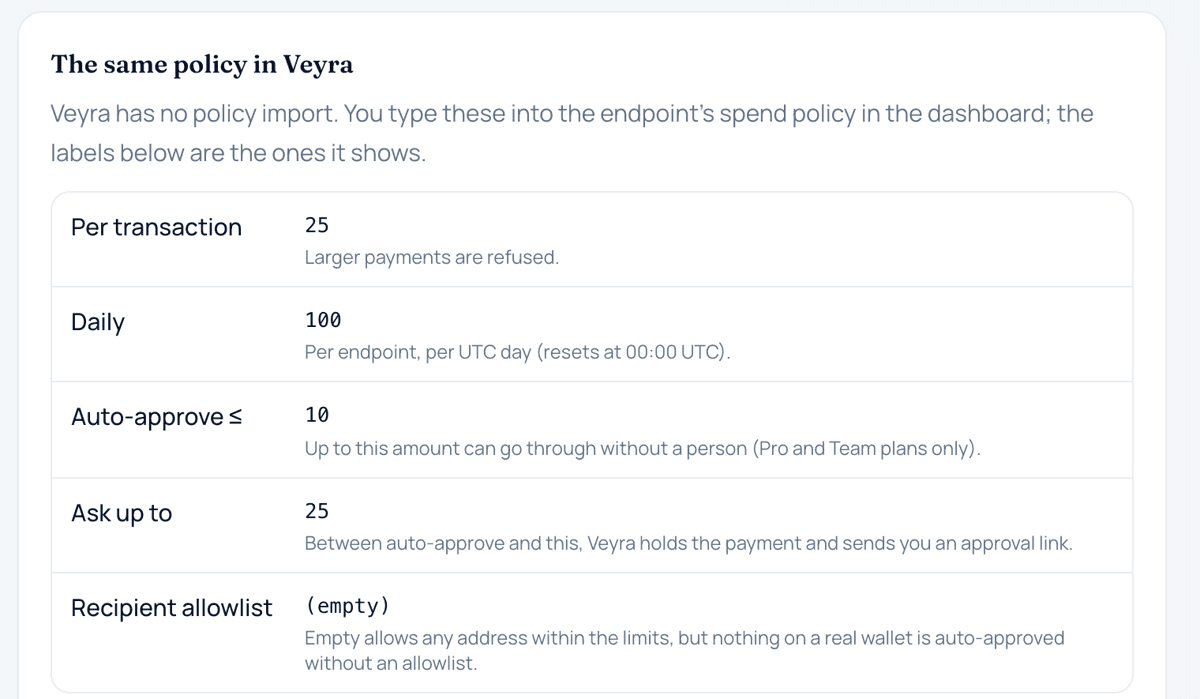
Veyra is the fourth kind: a permission layer between an agent and a wallet you already have. The agent gets one MCP endpoint with tools such as get_budget and create_payment, and never holds a key; Veyra never asks for a seed phrase or private key and doesn't hold your funds. Your per-payment, daily, auto-approve and ask limits and your recipient allowlist are enforced server-side. Payments are in USDC on Base, signed by you in your wallet through a one-tap approval link or, on Pro and Team, paid from a capped allowance. Veyra doesn't offer custodial balances, agent-held keys or smart-account session keys. For how custody arrangements compare in more depth, see the custodial vs non-custodial guide.
Sources
- Coinbase AgentKit (GitHub)
- Coinbase Developer Platform: Non-custodial wallets (user and API key wallets)
- Coinbase Developer Platform: Policy Engine
- Coinbase Developer Platform: Smart Accounts
- Coinbase Developer Platform: Spend Permissions
- Coinbase Developer Platform: Wallet MCP
- ERC-4337: Account Abstraction Using Alt Mempool
- ERC-7715: Request Permissions from Wallets (draft)
- Veyra docs
Terms on this page
- Smart account (ERC-4337)A smart account is a blockchain account controlled by smart contract code rather than a single private key, so it can apply its own rules to every transaction; ERC-4337 is the Ethereum standard that supports them without changing the core protocol.
- Token allowance (ERC-20 approve)A token allowance is the amount of an ERC-20 token that an owner has authorised a specific spender address to transfer from the owner's account, set with approve and spent with transferFrom.
- Recipient allowlistA recipient allowlist is a list of approved payees, such as wallet addresses, that a payment system checks before it lets an agent pay; payments to anyone not on the list are held or refused.
- Stablecoin (USDC)A stablecoin is a blockchain token designed to keep a stable value relative to a reference asset, usually a currency such as the US dollar; USDC is a dollar stablecoin issued by Circle.
This page explains how agent payments and the related technology work. It is not financial, investment, legal or tax advice. Protocols and provider features change; check the linked official sources before relying on a detail.