Comparisons
Agentic Commerce Protocol vs MCP
MCP connects AI apps to tools and data; ACP runs checkout between an agent and a business. Why they aren't alternatives, and how ACP can run over MCP.
They work at different layers: the Model Context Protocol is a general way for AI applications to connect to tools and data, while the Agentic Commerce Protocol defines one specific job, checkout between an AI agent and a business. ACP's own site says a business can publish its checkout as a traditional API or over MCP.
Why is this harder than it sounds?
Both are 'protocols for agents', both are open, and both turn up in the same announcements, so people ask which to adopt. It is a bit like asking whether to use HTTP or a payments API. MCP says how an agent finds and calls tools of any kind; it has nothing to say about carts, orders or payment tokens. ACP says what a checkout looks like, who keeps the customer, and how payment credentials reach the seller; it doesn't care much how the messages are carried. Most real systems that use ACP will also use something like MCP or REST to reach it.
How do you do it?
- Who made it. Anthropic open-sourced MCP in November 2024; the specification is now published at modelcontextprotocol.io. ACP was developed by Stripe and OpenAI, is open source under Apache 2.0, and is maintained by OpenAI and Stripe.
- What it is for. The MCP specification describes an open protocol for integrating LLM applications with external data sources and tools, using JSON-RPC 2.0 between hosts, clients and servers. ACP is an open standard for connecting buyers, their AI agents and businesses to complete purchases.
- What it defines. MCP servers offer resources, prompts and tools; a tool is any function the model can ask to run. ACP defines an Agentic Checkout API and a Delegate Payment spec, plus extensions such as discounts, covering physical goods, digital goods, subscriptions and asynchronous purchases.
- Payments and consent. MCP has no payment primitives. Its spec says hosts must obtain explicit user consent before invoking any tool, and leaves enforcement to implementors. ACP passes the buyer's credential to the business as a token, such as a Stripe Shared Payment Token, so the agent and the merchant never handle raw card details.
- Who sits on each side. An MCP server can be anything: a database, a file system, a payment tool. On the other side of an ACP checkout is a business that, per ACP's site, stays merchant of record and decides what is sold and how orders are fulfilled.
- How they fit together. ACP's site says checkout configuration can be published with a traditional API or MCP, and its 2026-04-17 release notes list MCP among the areas covered. So an agent could reach a merchant's ACP checkout through an MCP connection.
- When to use which. If you are giving an agent a capability, payments included, MCP is how it connects. If you are a business letting AI platforms buy from you, ACP is the commerce contract. Many will use both.
What it does not mean
- MCP isn't a payments protocol. A payment tool over MCP is just a tool; the limits and approvals have to come from the server behind it.
- ACP isn't an agent framework. It doesn't tell an agent how to discover or call tools in general.
- Supporting MCP doesn't make you ACP-compatible, and the reverse is also true. They are separate specifications.
Common questions
Can an MCP tool complete an ACP checkout?
In principle, yes: ACP's site says businesses can expose checkout over MCP. What a given agent platform supports is up to that platform.
Does MCP have built-in spending limits?
No. The MCP spec asks hosts to get user consent before invoking tools, but any spending limit has to be enforced by the payment service behind the tool.
Who governs each protocol?
ACP's repository says OpenAI and Stripe jointly govern it as founding maintainers. The MCP specification is developed in the open at modelcontextprotocol.io.
Where does Veyra fit?
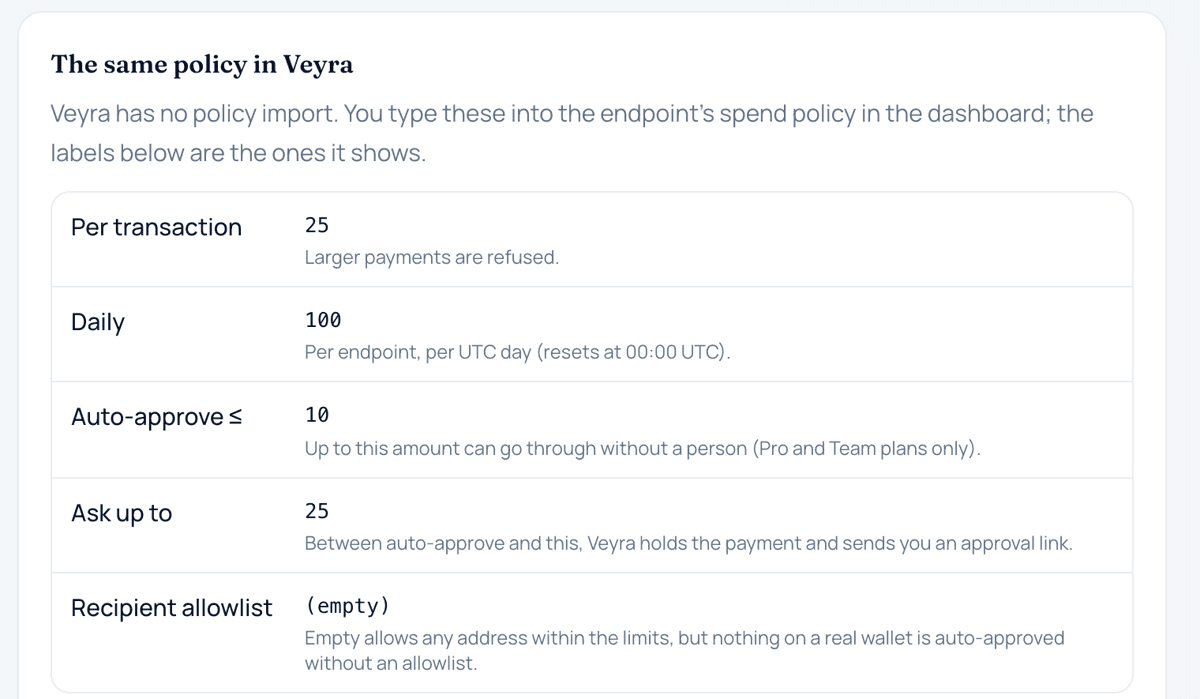
Veyra uses MCP and not ACP. It is a remote MCP server at https://veyra.money/api/mcp with tools such as get_budget, create_payment and get_payment, and it enforces your per-payment, daily, auto-approve and ask limits and recipient allowlist server-side, outside the model. It pays USDC on Base from your own wallet. It doesn't implement ACP checkout, issue payment tokens or accept payments for merchants.
Sources
Terms on this page
- MCP serverAn MCP server is a service that offers tools, resources or prompts to AI applications using the Model Context Protocol, an open protocol built on JSON-RPC 2.0.
- Merchant of record (MoR)The merchant of record is the business legally responsible for selling to the customer and processing their payment, including refunds, chargebacks, tax and payment compliance.
- Shared Payment Token (SPT)A Shared Payment Token (SPT) is a Stripe credential that grants an agent or seller scoped use of a customer's payment method, such as a card, with usage and expiration limits.
This page explains how agent payments and the related technology work. It is not financial, investment, legal or tax advice. Protocols and provider features change; check the linked official sources before relying on a detail.