Concepts and protocols
What is the Agentic Commerce Protocol (ACP)?
ACP lets an AI agent check out with a business that stays merchant of record. Who maintains it, how checkout and token payment work, and what to check now.
The Agentic Commerce Protocol (ACP) is an open standard, maintained by OpenAI and Stripe, that lets an AI agent complete a purchase with a business on a buyer's behalf. The business stays merchant of record, and payment passes as a scoped token, such as Stripe's Shared Payment Token, rather than a card number.
Why is this harder than it sounds?
For a business, selling through an AI assistant raises three worries: losing the customer relationship to the platform, handing card numbers to software, and building a separate integration for every assistant. ACP answers each one. The business keeps control of its products, pricing, fulfilment and customer relationship as merchant of record; the agent never holds raw card details; and one checkout API serves any agent that speaks the protocol. What makes it harder to follow than it sounds is that the protocol and the products built on it move at different speeds: the spec is still marked beta with dated versions, and the shopping features in ChatGPT that launched it have changed since.
How do you do it?
- The buyer asks the agent. The buyer describes what they want; the agent finds products, for example from a merchant's product feed, and helps them choose.
- The agent runs a checkout session. The agent creates and updates a checkout with the business through the endpoints defined in ACP's Agentic Checkout specification, published as OpenAPI with JSON Schemas. ACP supports REST and MCP integrations.
- Payment travels as a token. ACP has a separate Delegate Payment specification. With Stripe, the agent issues a Shared Payment Token that Stripe describes as scoped to a specific merchant and basket total, with a currency, maximum amount and expiry.
- The business charges and fulfils. The business uses the token to create a payment with Stripe, or resolves it to network credentials for another processor, then fulfils the order and handles support as merchant of record.
- Pin a spec version. ACP uses date-based versions. The repository lists 2025-09-29 as the initial release and 2026-04-17 as adding cart, feed, orders, authentication and MCP, with older versions kept and marked deprecated.
What it does not mean
- ACP isn't a payment network or a wallet. It coordinates checkout and passes payment tokens; a payment provider still processes the charge.
- The AI platform isn't the seller. The business remains merchant of record.
- ACP isn't the same thing as Instant Checkout. Instant Checkout was a ChatGPT feature built on ACP; the protocol is separate and other agents can implement it.
- It isn't locked to one provider. agenticcommerce.dev calls Stripe the first compatible payment provider, and the spec addresses payment providers generally.
Common questions
Who created ACP?
Stripe and OpenAI developed it. It is open source under Apache 2.0, and the repository lists OpenAI and Stripe as founding maintainers, with broader community governance planned.
Is Instant Checkout still in ChatGPT?
Stripe announced Instant Checkout in ChatGPT, built on ACP, on 29 September 2025. OpenAI's current commerce docs describe payment through merchants' own checkouts, plugins and ChatGPT Wallet and don't mention Instant Checkout, so check OpenAI's docs for what is live today.
How is ACP different from AP2?
ACP standardises the checkout between an agent and a business. AP2 standardises proof of what the user authorised, as signed mandates. The ACP vs AP2 comparison covers where they overlap.
Do I need Stripe to use ACP?
Stripe is the first compatible payment provider and publishes the reference implementation for sellers. Stripe also documents resolving a Shared Payment Token to network credentials for use with a third-party processor.
Where does Veyra fit?
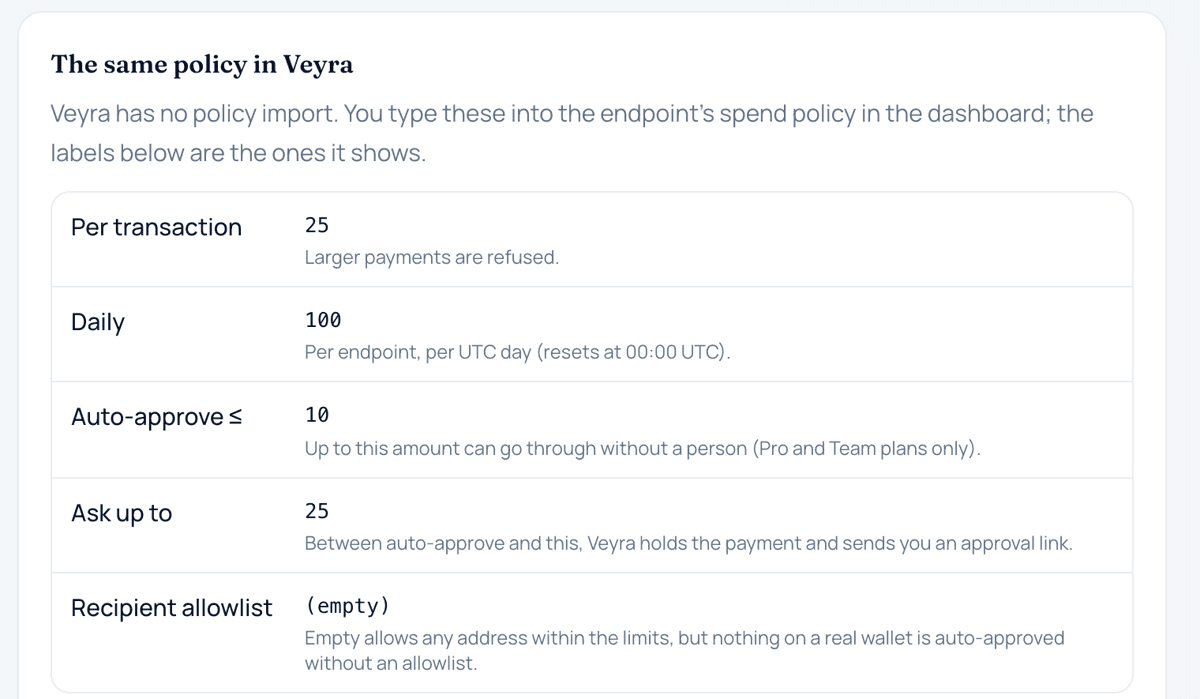
Veyra doesn't implement ACP and isn't on the merchant side: it doesn't accept payments for businesses. It sits on the payer side, letting an agent request USDC payments on Base from the owner's own wallet within per-payment, daily, auto-approve and ask limits and a recipient allowlist. If your agent needs to buy from merchants that take cards through ACP, you need an ACP-capable agent platform and a payment token such as Stripe's; Veyra suits payees that accept a USDC transfer on Base.
Sources
Terms on this page
- Shared Payment Token (SPT)A Shared Payment Token (SPT) is a Stripe credential that grants an agent or seller scoped use of a customer's payment method, such as a card, with usage and expiration limits.
- Merchant of record (MoR)The merchant of record is the business legally responsible for selling to the customer and processing their payment, including refunds, chargebacks, tax and payment compliance.
- MCP serverAn MCP server is a service that offers tools, resources or prompts to AI applications using the Model Context Protocol, an open protocol built on JSON-RPC 2.0.
This page explains how agent payments and the related technology work. It is not financial, investment, legal or tax advice. Protocols and provider features change; check the linked official sources before relying on a detail.