Concepts and protocols
What is the Machine Payments Protocol (MPP)?
MPP lets a server charge an AI agent per request over HTTP 402. Who made it, the challenge, credential and receipt flow, sessions, and the payment methods.
The Machine Payments Protocol (MPP) is an open protocol, co-authored by Stripe and Tempo, that lets a server charge an agent for an API call or other resource over HTTP 402. The server sends a payment challenge, the agent retries with a payment credential, and the server returns the resource with a receipt.
Why is this harder than it sounds?
Selling an API usually means sign-up, a plan and a stored card, all of which need a person. An agent in the middle of a task can't stop to do that. MPP, like x402, turns the HTTP 402 Payment Required status into a working exchange so a client can pay for exactly what it uses. Its particular choices are worth knowing before you pick it: the core is written as an HTTP authentication scheme and has been submitted to the IETF; each payment method, card or stablecoin, is defined separately by the rail behind it; and besides one-off charges it defines sessions for metered, pay-as-you-go use. None of this decides how much a given agent may spend; that still has to be set wherever the agent's credential lives.
How do you do it?
- The agent requests a paid resource. An ordinary HTTP request, with no payment attached.
- The server answers 402 with a challenge. The challenge travels in the WWW-Authenticate header using the Payment scheme. It tells the client what the resource costs and which payment methods it can use.
- The agent pays and sends a credential. The client sends a payment credential in the Authorization header with the Payment scheme, or in Payment-Authorization when the challenge asks for that, so the request can keep its own application authentication. The server verifies the credential against the challenge it issued.
- The server returns the resource and a receipt. On success the response carries a receipt in the Payment-Receipt header.
- Choose the intent. MPP defines a charge intent for one-off payments, a session intent for metered pay-as-you-go use where the buyer reserves funds once and pays as they go, and a subscription intent for recurring fixed payments.
- Choose the payment methods. mpp.dev lists methods including Tempo stablecoins, Stripe (Shared Payment Tokens and stablecoins), cards, Lightning and Solana. On Stripe, MPP accepts cards through Shared Payment Tokens and stablecoins as USDC.e on Tempo or USDC on Solana, settling to your Stripe balance.
What it does not mean
- MPP isn't Stripe-only. The core spec is maintained through the IETF, and each payment method is maintained by the rail behind it.
- It isn't the same as x402, though they solve the same problem. mpp.dev says its SDK also supports x402 exact flows, and Stripe supports both protocols.
- It isn't only crypto. Card payments work through Shared Payment Tokens, which carry usage and expiry limits.
- It isn't a budget for the agent. MPP defines how a server asks for payment, not how much a particular agent is allowed to pay.
Common questions
Who created MPP?
MPP is co-authored by Tempo and Stripe. Its core specification is published as the Payment HTTP Authentication Scheme and has been submitted to the IETF, with development on GitHub.
What's the difference between MPP and x402?
Both use HTTP 402 for pay-per-request. MPP is built as an HTTP authentication scheme with separate payment-method specs and adds session and subscription intents; x402 uses its own payment headers and stablecoin schemes. The x402 vs MPP comparison goes through the details.
Can I test an MPP endpoint without real money?
Stripe's guide covers a sandbox using a test Stripe profile and the Tempo testnet, and an mppx validate command that checks discovery, challenge formats and the full payment flow. In live mode the same command can move real funds.
Where does Veyra fit?
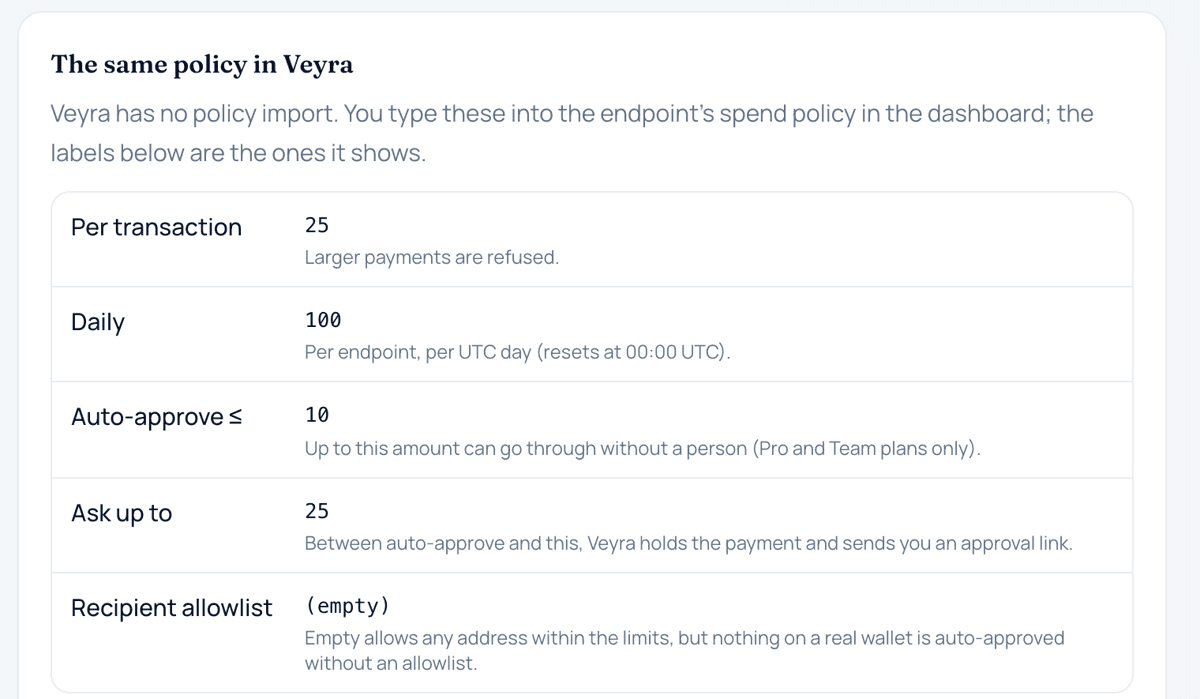
Veyra doesn't implement MPP and can't answer an MPP challenge. Its create_payment tool sends a USDC transfer on Base to a recipient address you allow, and Base isn't among the MPP networks Stripe lists (Stripe lists Base for x402). Where Veyra does fit is the question MPP leaves open: how much your agent may pay and to whom. Veyra applies per-payment, daily, auto-approve and ask limits and a recipient allowlist before any payment, which makes it suited to providers that accept a direct USDC transfer on Base rather than a protocol challenge.
Sources
Terms on this page
- HTTP 402 Payment Required402 Payment Required is an HTTP response status code that RFC 9110 lists as 'reserved for future use', meaning HTTP itself defines no standard behaviour for it.
- Shared Payment Token (SPT)A Shared Payment Token (SPT) is a Stripe credential that grants an agent or seller scoped use of a customer's payment method, such as a card, with usage and expiration limits.
- Stablecoin (USDC)A stablecoin is a blockchain token designed to keep a stable value relative to a reference asset, usually a currency such as the US dollar; USDC is a dollar stablecoin issued by Circle.
This page explains how agent payments and the related technology work. It is not financial, investment, legal or tax advice. Protocols and provider features change; check the linked official sources before relying on a detail.