Comparisons
x402 vs MPP
x402 and the Machine Payments Protocol both use HTTP 402. Who made each, the headers, what each pays with, how settlement works, and when to use which.
Both let a server answer 402 Payment Required and get paid inside the same HTTP request. x402, created by Coinbase and now stewarded by the x402 Foundation, registers schemes per blockchain network, while MPP, co-authored by Tempo and Stripe, is payment-method agnostic, covering stablecoins, cards and other rails through separate method specs.
Why is this harder than it sounds?
From a distance the two look identical: request, 402, pay, retry, resource. The differences are in the details a builder actually hits: different headers, a different idea of what a payment method is, different ways of handling many tiny charges, and different organisations behind them. Stripe supports both, which adds to the confusion, because the same Stripe account can accept either and the money lands in the same balance. Choosing comes down to who your paying clients are and which rails they can use.
How do you do it?
- Who made it. The Linux Foundation describes x402 as created by Coinbase, and in April 2026 announced the x402 Foundation as its neutral home, with Coinbase contributing the protocol. MPP is an open protocol co-authored by Tempo and Stripe; Stripe announced it in March 2026.
- What goes over the wire. x402 defines its own headers: the server sends terms in PAYMENT-REQUIRED, the client pays in PAYMENT-SIGNATURE, and the server confirms in PAYMENT-RESPONSE. MPP builds on HTTP authentication: the challenge is WWW-Authenticate: Payment, the client answers with Authorization: Payment, and a Payment-Receipt header comes back. That core scheme has been submitted to the IETF as an individual Internet-Draft by authors from Tempo Labs and Stripe.
- What it pays with. x402 registers schemes for blockchain networks, such as exact (a set amount) and upto (a maximum per request), and its README says it aims to support fiat as well. MPP's FAQ describes it as payment-method agnostic, with stablecoins, cards, wallets and custom rails defined in separate payment method specifications. Stripe documents card payments on MPP through Shared Payment Tokens.
- How the payment is authorised. In x402 the client signs a payment payload; on EVM chains the exact scheme defaults to an EIP-3009 transferWithAuthorization signature, and a facilitator can verify and settle it but cannot change the amount or destination. In MPP the client returns a credential containing proof of payment; for cards that is a Shared Payment Token, which Stripe describes as a scoped grant with usage and expiration limits.
- Many small charges. MPP's FAQ describes sessions: the buyer deposits into a channel reserve, signs off-chain vouchers for many requests, and the seller settles on-chain periodically. The x402 repository lists a batch-settlement scheme on EVM that likewise uses escrow and off-chain vouchers redeemed in batches.
- Networks Stripe lists. Stripe's machine payments docs list MPP on Tempo and Solana and x402 on Base, all in USDC variants, with payments landing in the Stripe balance and settling in fiat. Outside Stripe, x402's own site says it supports EVM-compatible chains, Solana and more.
- When to use which. If your paying clients are agents with stablecoin wallets on chains x402 supports, x402 is the narrower, crypto-first fit. If you want card payments as well as stablecoins behind one 402 flow, MPP is built for that. Stripe lets one account accept both, so supporting two is an option rather than a contradiction.
What it does not mean
- MPP isn't a renamed x402. The headers, the method model and the organisations behind them differ, though MPP's FAQ says x402's core exact flows map onto MPP's charge intent.
- Neither is a Stripe-only or Coinbase-only protocol. Both are published as open specifications; Stripe is one processor that supports both.
- Neither decides how much an agent may spend. Both define how to pay a server that asks, not whether a given agent should.
Common questions
Can one API accept both x402 and MPP?
Yes. Stripe's machine payments docs offer integration guides for both and settle both into the same Stripe balance. Nothing in either spec stops a server offering both.
Is MPP an IETF standard?
Not yet. The core 'Payment' HTTP authentication scheme is an active individual Internet-Draft, which the IETF datatracker notes has no formal standing. Payment method specs are published separately.
Who runs x402 now?
The Linux Foundation launched the x402 Foundation as its neutral home in April 2026, with the protocol contributed by Coinbase. The specification lives in the x402-foundation organisation on GitHub.
Does either support Lightning?
MPP's FAQ names Lightning as one example of a rail with its own payment method. For an HTTP 402 protocol built entirely on Lightning, see L402.
Where does Veyra fit?
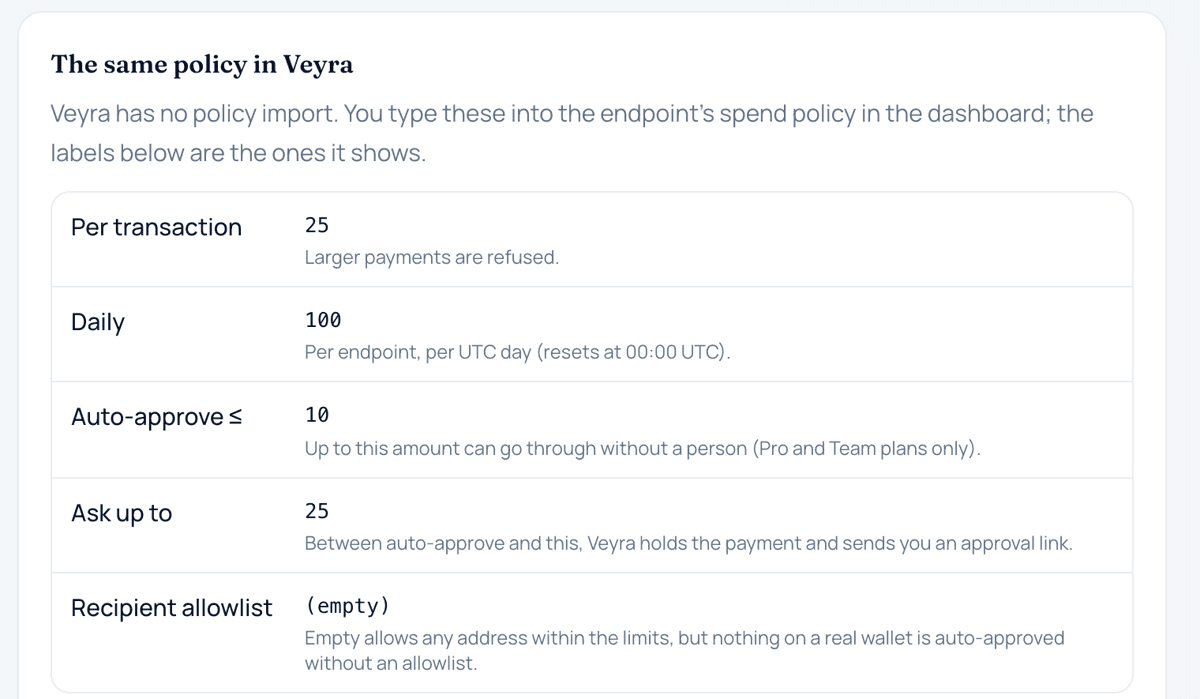
Veyra implements neither x402 nor MPP. It is the payer-side permission layer: an agent calls create_payment on Veyra's MCP endpoint, and Veyra applies your per-payment, daily, auto-approve and ask limits and your recipient allowlist before sending USDC on Base from your own wallet, signed by you or, on paid plans, from a capped allowance. It can't answer a 402 challenge from either protocol. It suits payees that accept a direct USDC transfer to an address, with get_payment returning the transaction reference as proof.
Sources
- x402 specification and reference implementation (GitHub)
- x402.org
- Linux Foundation: launching the x402 Foundation with the contribution of the x402 protocol
- MPP: Machine Payments Protocol overview
- MPP: FAQ
- IETF Internet-Draft: The "Payment" HTTP Authentication Scheme
- Stripe blog: Introducing the Machine Payments Protocol
- Stripe docs: Machine payments (MPP and x402)
- Stripe docs: Shared payment tokens
Terms on this page
- HTTP 402 Payment Required402 Payment Required is an HTTP response status code that RFC 9110 lists as 'reserved for future use', meaning HTTP itself defines no standard behaviour for it.
- x402 facilitatorAn x402 facilitator is a service that verifies x402 payment payloads and settles them on-chain on behalf of a resource server, through /verify and /settle endpoints.
- Shared Payment Token (SPT)A Shared Payment Token (SPT) is a Stripe credential that grants an agent or seller scoped use of a customer's payment method, such as a card, with usage and expiration limits.
- Stablecoin (USDC)A stablecoin is a blockchain token designed to keep a stable value relative to a reference asset, usually a currency such as the US dollar; USDC is a dollar stablecoin issued by Circle.
This page explains how agent payments and the related technology work. It is not financial, investment, legal or tax advice. Protocols and provider features change; check the linked official sources before relying on a detail.