Concepts and protocols
Stablecoin payments for AI agents
Why AI agents pay in stablecoins like USDC, what an agent needs (wallet, network, gas, allowlist) and the risks of a payment that can't be pulled back.
AI agents pay in stablecoins such as USDC by sending a token transfer on a blockchain network, either straight to a recipient's address or in answer to an HTTP 402 challenge under a protocol like x402. To do it safely an agent needs a funded wallet on the right network, a way to cover network fees, and limits on how much it can pay and to whom.
Why is this harder than it sounds?
Stablecoins suit software. Circle describes USDC as programmable and redeemable 1:1 for US dollars, with transactions available 24/7, so an agent can pay at three in the morning without a bank's opening hours or a checkout page. Small amounts work, because there's no card minimum or merchant account involved, and protocols like x402 let a server state a price inside an ordinary HTTP response. The catch is that the properties that make it easy also make it unforgiving. Base's own docs warn that a direct USDC transfer has no escrow, authorisation or protocol-managed refund flow. A payment to the wrong address or on the wrong network is generally gone, and an agent that can sign transfers can sign as many as its key allows.
How do you do it?
- Pick the network and the exact token. USDC exists on many networks, and a payee on one can't receive on another. Check the token contract address against Circle's published list rather than trusting a token's name; lookalike tokens can copy a name and symbol.
- Decide who holds the wallet. A custodial balance, a key the agent or its server controls, a smart account with spend permissions, or your own wallet behind a policy layer. This decides what an attacker who reaches the agent could do.
- Cover network fees. Every Base transaction pays a network fee made of an L2 execution fee and an L1 security fee, normally paid in ETH, so the sending wallet needs some. Circle's Paymaster lets ERC-4337 smart accounts pay gas in USDC instead, and an x402 facilitator generally submits the payment and pays the gas for the payer.
- Choose how the agent pays. A direct transfer to an address the seller publishes; x402, where the agent signs a payment payload in answer to a 402 response; or MPP, which Stripe documents for stablecoins on Tempo and Solana alongside cards. Stripe lists x402 for USDC on Base.
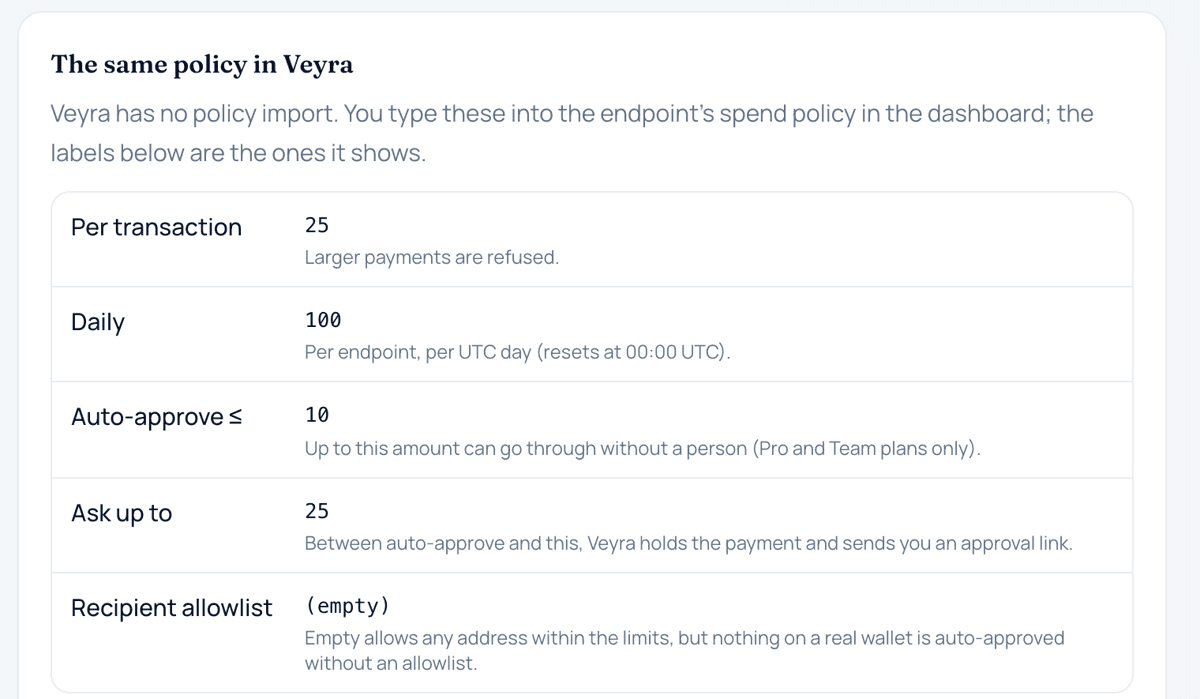
- Set limits and an allowlist outside the agent. A per-payment cap, a daily cap and a list of addresses the agent may pay, all enforced by the wallet or payment service, not by the prompt.
- Verify before treating it as paid. Base's docs say to confirm the transaction receipt succeeded and that its USDC Transfer event matches the expected sender, recipient and amount. Keep the transaction hash as the record.
What it does not mean
- A stablecoin isn't a bank deposit. It is a token whose value depends on its issuer's reserves and redemption, which is why issuers publish both.
- On-chain doesn't mean anonymous. Transfers and addresses are public on the network's explorer.
- Low fees don't make mistakes cheap. The fee is small; a payment sent to the wrong address is the full amount.
- Supporting USDC doesn't mean supporting every network it's on. Payer and payee must be on the same one.
Common questions
Why USDC rather than ETH or another token?
Agents usually pay prices set in dollars, and a dollar stablecoin keeps the amount stable between quote and payment. This page doesn't recommend holding any asset.
Can an agent get a refund on a stablecoin payment?
Only if the seller sends one back. Base notes that a direct USDC transfer has no protocol-managed refund flow, so agree terms with the seller first.
Does the agent need ETH as well as USDC?
To submit its own transactions on Base, the sending wallet needs ETH for gas unless a paymaster or facilitator covers it.
Is this financial advice?
No. It explains how stablecoin payments work for agents, not what to buy or hold.
Where does Veyra fit?
Veyra pays in USDC on Base only. An agent calls create_payment with an amount, recipient, network, reason and idempotency key; Veyra checks it against your per-payment, daily, auto-approve and ask limits and your recipient allowlist, comparing addresses canonically. Then either you sign the transfer in your own wallet, which submits it and pays the network fee, or, on Pro and Team, Veyra's relayer submits it from a capped allowance on your wallet. Once confirmed, get_payment returns the transaction reference and an explorer link. Veyra doesn't implement x402 or MPP, doesn't hold funds, and offers a simulated source for testing with no real money.
Sources
Terms on this page
- Stablecoin (USDC)A stablecoin is a blockchain token designed to keep a stable value relative to a reference asset, usually a currency such as the US dollar; USDC is a dollar stablecoin issued by Circle.
- Base (network)Base is an Ethereum layer 2 network built by Coinbase: a rollup whose transaction data is posted to Ethereum, with its own chain ID (8453 for Base Mainnet).
- x402 facilitatorAn x402 facilitator is a service that verifies x402 payment payloads and settles them on-chain on behalf of a resource server, through /verify and /settle endpoints.
- Recipient allowlistA recipient allowlist is a list of approved payees, such as wallet addresses, that a payment system checks before it lets an agent pay; payments to anyone not on the list are held or refused.
This page explains how agent payments and the related technology work. It is not financial, investment, legal or tax advice. Protocols and provider features change; check the linked official sources before relying on a detail.