Concepts and protocols
What are Visa's and Mastercard's AI agent payment standards?
How Visa Intelligent Commerce, Visa's Trusted Agent Protocol and Mastercard Agent Pay let agents pay by card without the card number, and what each one needs.
Visa and Mastercard each run programmes that let AI agents pay by card without handling the card number. Visa Intelligent Commerce uses tokenised credentials and Visa Payment Passkeys, and its Trusted Agent Protocol lets merchants verify an agent's signed requests; Mastercard Agent Pay uses Mastercard Agentic Tokens and requires agents to be registered and verified.
Why is this harder than it sounds?
Card payments assume a cardholder at a checkout or a merchant holding a card on file for known reasons. An agent fits neither. Merchants' bot defences are built to block automated traffic, so a legitimate shopping agent can look like an attack; issuers need to know a payment was started by an agent and approved by the cardholder; and nobody wants card numbers sitting in an agent's context. The networks' answer is to extend tokenisation, which they already use for mobile wallets and card-on-file, so an agent gets its own credential tied to the cardholder's consent, and to give merchants a way to recognise approved agents. These are network programmes rather than open protocols, so access comes through onboarding and partners.
How do you do it?
- Visa Intelligent Commerce: enrol and tokenise. A card is enrolled and a token provisioned, and the raw card number isn't kept for later use. The agent binds the user's device, with step-up authentication if the issuer requires it, and registers a Visa Payment Passkey.
- Visa Intelligent Commerce: approve an instruction. The consumer approves a purchase instruction with their passkey, and only then can the agent retrieve credentials for that instruction. Visa's developer docs describe Sandbox, Certification and Production environments, each needing Visa approval before moving on.
- Visa Trusted Agent Protocol: verify the agent. Announced on 14 October 2025 and developed with Cloudflare, it builds on HTTP Message Signatures (RFC 9421). An approved agent signs its requests and the merchant checks the signature with the agent's public key. The signature can also carry consumer recognition data and optional payment information. Visa publishes it on the Visa Developer Center and GitHub.
- Mastercard Agent Pay: agentic tokens. Launched on 29 April 2025, Agent Pay introduces Mastercard Agentic Tokens, built on the tokenisation already used for contactless and card-on-file payments. Agents must be registered and verified before they can pay, and Mastercard says consumers control what an agent is allowed to buy.
- Mastercard rollout and tools. In September 2025 Mastercard said all US Mastercard cardholders would be enabled for Agent Pay by the holiday season, with a global rollout to follow. It also launched an Agent Toolkit that serves its API docs over MCP, and said it was working with the FIDO Alliance on a verifiable credential standard confirming amount, merchant and product.
- How a merchant receives these tokens. Often through a payment provider. Stripe says that, with the card networks, it may use tokens from Mastercard Agent Pay, Visa Intelligent Commerce and American Express ACE Kit on a seller's behalf, and a resolved Shared Payment Token can come back as an agentic_token credential.
What it does not mean
- They aren't open protocols you can switch on. Visa requires approval at each environment, and Mastercard requires agents to be registered and verified.
- An agentic token isn't a card number to paste into a prompt. It is a network credential provisioned for agent use, tied to the cardholder's consent.
- Trusted Agent Protocol identifies the agent; it isn't a payment method in itself, although its signatures can carry optional payment data.
- Availability isn't uniform. Check Visa's and Mastercard's own pages for which markets, cards and partners are live.
Common questions
Do I integrate with Visa or Mastercard directly?
Merchants usually reach these programmes through their payment provider or acquirer. Visa's developer pages list merchants and independent developers as audiences for Intelligent Commerce and Trusted Agent Protocol, with onboarding and approval before production.
How do these relate to ACP, AP2 and MPP?
They sit underneath. A Stripe Shared Payment Token used with ACP or MPP may be backed by a network agentic token, and Google says it donated AP2 to the FIDO Alliance alongside Verifiable Intent, a standard co-developed with Mastercard.
Can an agent pay by card without these programmes?
Yes, through a virtual card with spending controls or a scoped token from a payment provider. The network programmes add agent-specific tokens and ways for merchants to recognise approved agents.
Where does Veyra fit?
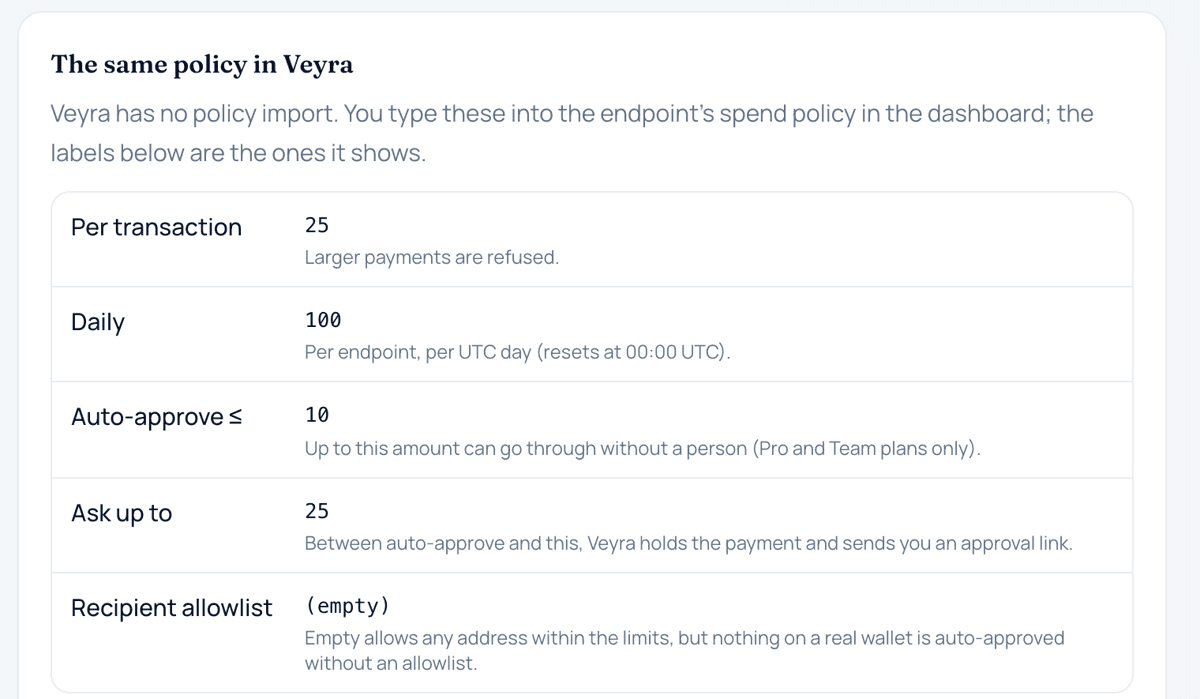
Veyra doesn't use these programmes and doesn't issue cards or card tokens. It controls payments in USDC on Base from a wallet the owner already has, with per-payment, daily, auto-approve and ask limits and a recipient allowlist checked server-side before anything is paid. If your agent has to pay merchants that only take cards, a card route through a provider that supports network agent tokens is the one to look at; Veyra suits payees that accept a USDC transfer on Base.
Sources
- Visa Developer: Visa Intelligent Commerce
- Visa Developer: Trusted Agent Protocol
- Visa: Visa Introduces Trusted Agent Protocol
- Mastercard: Mastercard unveils Agent Pay
- Mastercard: New tools and collaborations to power smarter, safer agentic commerce
- Stripe docs: Shared payment tokens
- Google: AP2 v0.2 and donation to the FIDO Alliance
Terms on this page
- Know Your Agent (KYA)Know Your Agent (KYA) is an emerging, not yet standardised term for verifying an AI agent's identity and linking it to the person or business it acts for, by analogy with Know Your Customer checks.
- Shared Payment Token (SPT)A Shared Payment Token (SPT) is a Stripe credential that grants an agent or seller scoped use of a customer's payment method, such as a card, with usage and expiration limits.
This page explains how agent payments and the related technology work. It is not financial, investment, legal or tax advice. Protocols and provider features change; check the linked official sources before relying on a detail.