Concepts and protocols
What are agentic payments?
Payments an AI agent starts for someone. The rails agents pay over, how each one delegates a credential, and the control problem to settle first.
Agentic payments are payments an AI agent initiates on behalf of a person or business, using a credential that person delegated to it: a card network token, a scoped payment token, a stablecoin wallet or, on some protocols' roadmaps, a bank transfer. The money moves over existing rails; what changes is who decides to send it.
Why is this harder than it sounds?
Agentic commerce is the whole buying journey: finding a product, building a cart, checking out and getting it delivered. Agentic payments are the one step in it where money moves, and they also happen outside shopping, for example when an agent pays per call for an API. That step was designed around a person: someone types a card number, sees a total and can be asked to confirm. An agent has none of that context by default. It acts on text it reads, it may run while nobody is watching, and the business it pays can't easily tell an authorised agent from an attacker using the same credential. So the hard part isn't moving money; card networks, stablecoins and bank transfers already do that. It's delegation: giving the agent a credential narrow enough that a mistake or a prompt injection can't cost more than you agreed to, and giving the payee enough proof to accept it.
How do you do it?
- Decide whether the agent requests or executes. In the safest setup the agent asks and a person, or a policy outside the model, approves. In the most autonomous one the agent holds a credential it can spend without asking. Most real setups sit in between: small payments pass on their own, larger ones wait for a person.
- Card rails: tokens instead of card numbers. The card networks provision agent-specific tokens rather than letting an agent use the card number. Visa Intelligent Commerce uses tokenised credentials and Visa Payment Passkeys; Mastercard Agent Pay introduces Mastercard Agentic Tokens. Stripe's Shared Payment Token goes further and scopes a grant to a seller, with a maximum amount, a currency and an expiry.
- Stablecoin rails: pay per request. Machine payment protocols such as x402 and the Machine Payments Protocol (MPP) let a server answer a request with HTTP 402 and a price, which the agent pays and retries. Stripe lists x402 for USDC on Base and MPP on Tempo and Solana, and MPP also accepts cards through Shared Payment Tokens.
- Bank transfers: mostly roadmap. The AP2 documentation says its initial version supports 'pull' methods such as credit and debit cards, and lists 'push' payments such as real-time bank transfers (UPI and PIX, for example) on its roadmap. Check each protocol's own site for what is live.
- Proof of authorisation. A payee needs to know the agent was allowed to pay. AP2 records the user's approval as signed mandates; Visa's Trusted Agent Protocol lets an agent sign its requests so a merchant can verify it; Mastercard requires agents to be registered and verified before they pay.
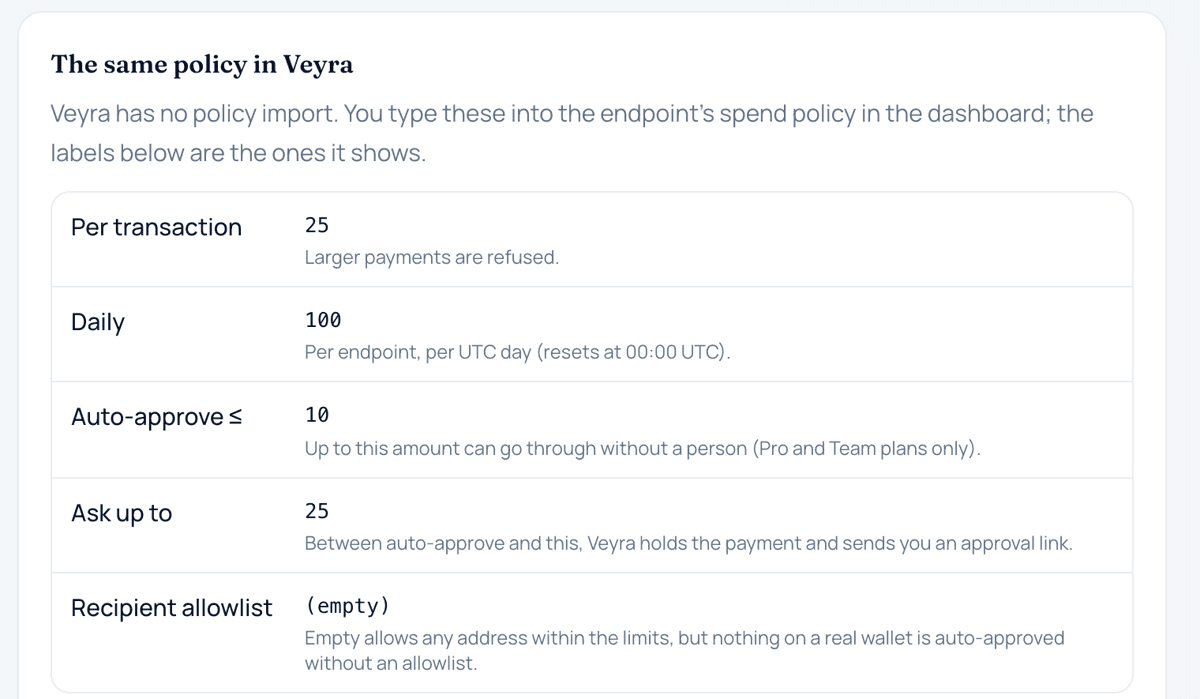
- Limits outside the model. Whichever rail you use, set the per-payment and daily maximum, the payees allowed and the approval threshold somewhere the agent can't edit, and keep a log of every decision. A model's instructions are not a spending limit.
What it does not mean
- It isn't a new kind of money. Agentic payments run over cards, stablecoins and, in places, bank transfers.
- It isn't the same as agentic commerce. Payment is one step of an agent buying something, and agents also pay where there is no shop at all, such as metered APIs.
- It doesn't mean the agent has your card number. The serious approaches pass tokens or scoped grants so the agent never holds the raw credential.
- It doesn't mean unattended by default. AP2, for example, defines both a human-present mode and a human-not-present mode.
Common questions
What's the difference between agentic payments and agentic commerce?
Agentic commerce is the whole journey of an agent shopping or transacting for someone, from discovery to delivery. Agentic payments are the money movement inside it, plus payments with no shopping attached, like an agent paying per call for an API.
Can an AI agent use my credit card?
It can, through network tokens or a scoped token such as Stripe's Shared Payment Token, which limit where and how much it can spend. Pasting the card number into an agent's prompt gives it, and anything that can read its context, the full card.
Who is responsible if an agent pays for the wrong thing?
It depends on the rail, the provider's terms and the country, and the rules are still settling. Protocols such as AP2 aim to produce a verifiable record of what the user approved so that disputes have evidence to work from.
Is this financial advice?
No. It explains how agentic payments work. It doesn't recommend any product, rail or asset.
Where does Veyra fit?
Veyra covers the stablecoin-wallet route with the control step built in. Your agent gets one MCP endpoint and calls create_payment with an amount, recipient, reason and idempotency key; Veyra checks it against your per-payment, daily, auto-approve and ask limits and your recipient allowlist, then pays in USDC on Base from a wallet you already own. You either sign each payment from a one-tap approval link, or on Pro and Team let small payments run from a capped allowance. Veyra doesn't issue cards, isn't a custodian and doesn't implement x402, MPP, AP2 or ACP, so it suits payees that accept a USDC transfer on Base.
Sources
- Stripe docs: Agentic commerce
- Stripe docs: Shared payment tokens
- Stripe docs: Machine payments (MPP and x402)
- AP2: Agent Payments Protocol
- Visa Developer: Visa Intelligent Commerce
- Visa Developer: Trusted Agent Protocol
- Mastercard: Mastercard unveils Agent Pay
- x402 specification and reference implementation (GitHub)
Terms on this page
- Shared Payment Token (SPT)A Shared Payment Token (SPT) is a Stripe credential that grants an agent or seller scoped use of a customer's payment method, such as a card, with usage and expiration limits.
- Stablecoin (USDC)A stablecoin is a blockchain token designed to keep a stable value relative to a reference asset, usually a currency such as the US dollar; USDC is a dollar stablecoin issued by Circle.
- AP2 mandateAn AP2 mandate is a cryptographically signed digital credential, defined by the Agent Payments Protocol, that records what a user authorised an AI agent to buy or pay for, so merchants and payment providers can verify it.
- Know Your Agent (KYA)Know Your Agent (KYA) is an emerging, not yet standardised term for verifying an AI agent's identity and linking it to the person or business it acts for, by analogy with Know Your Customer checks.
This page explains how agent payments and the related technology work. It is not financial, investment, legal or tax advice. Protocols and provider features change; check the linked official sources before relying on a detail.