Staying in control
Should you give an AI agent your credit card?
Why pasting a card number into an agent, prompt or autofill is risky, and the narrower options: virtual cards, delegated tokens and policy-controlled wallets.
Not the card itself. Pasting a card number into a prompt, an agent's config or browser autofill hands software a full credential with no per-merchant limit, copies it into logs and context, and leaves it open to prompt injection. Give the agent something narrower: a virtual card with spending controls, a scoped token, or a policy-controlled wallet.
Why is this harder than it sounds?
A card number is a bearer credential: whoever has the number, expiry and security code can try to pay with it, anywhere, up to your credit limit. Once it sits in an agent's context it travels with every request: to the model provider, into traces and logs, into memory files and anything else the agent framework keeps. The PCI Data Security Standard applies to entities that store, process or transmit cardholder data, and a prompt full of card details turns a pile of tools never designed for that into exactly such a system. Then there is the agent itself. OWASP lists prompt injection as the top risk for LLM applications; a page or email the agent reads can tell it to buy something, and a card has no idea which agent, task or merchant you meant.
How do you do it?
- Keep the number out of anything the model reads. That includes the system prompt, chat history, memory files, environment files the agent can open, and a browser profile whose autofill the agent can trigger. If the agent can read it, assume it can repeat it.
- Issue a dedicated virtual card instead. Card-issuing platforms let you create a separate card per agent with its own limits. Stripe Issuing's spending controls set amounts per authorisation or per period and allow or block merchant categories and countries, and real-time authorisations let your server approve or decline each charge.
- Use a delegated token where sellers accept one. Stripe's Shared Payment Token lets an agent use a customer's payment method through a scoped grant with usage and expiry limits, rather than the raw card details. Stripe uses it in the Agentic Commerce Protocol and in machine payments over MPP.
- Watch the card networks' agentic tokens. Visa Intelligent Commerce provisions tokens that agents store in place of the card number, and production access requires onboarding with Visa. Mastercard announced Agent Pay with Mastercard Agentic Tokens, built on its existing tokenisation, and says trusted agents must be registered and verified. Check each network's own pages for where these are live.
- Use a policy-controlled wallet for payees that take stablecoins. For APIs, data and other services that accept stablecoins, the agent can request payments from a wallet you own through a service that enforces amounts, recipients and approvals.
- Keep the limits outside the agent. Whichever route you take, the cap, the allowed payees and the approval step should live in the issuer or payment service, where an instruction in the agent's context can't change them.
What it does not mean
- A card with a low credit limit isn't a spending policy. The limit is the whole balance, available to any merchant, for as long as the number is valid.
- Telling the agent 'only use the card for X' in its prompt isn't a control. Instructions in the same context can override it.
- Browser autofill isn't safer than pasting. An agent driving the browser can fill and submit the card on any page it reaches.
- Virtual cards aren't payee-level controls. Merchant category limits still allow every merchant in an allowed category.
Common questions
Is it a breach of my card terms to give it to an AI agent?
That depends on your issuer's terms, which this page can't speak for. Check them, and prefer a card or token issued for the purpose.
Can I let an agent shop without seeing my card at all?
Yes, with tokenised routes such as Stripe's Shared Payment Token or the networks' agentic tokens, where the merchant and agent support them.
What if my agent already has my card number?
Treat it as exposed: ask your issuer to replace the card, remove the number from prompts, memory and logs, and move to a narrower route.
Is this financial advice?
No. It explains the risks and the alternatives. It doesn't recommend a card, issuer or provider.
Where does Veyra fit?
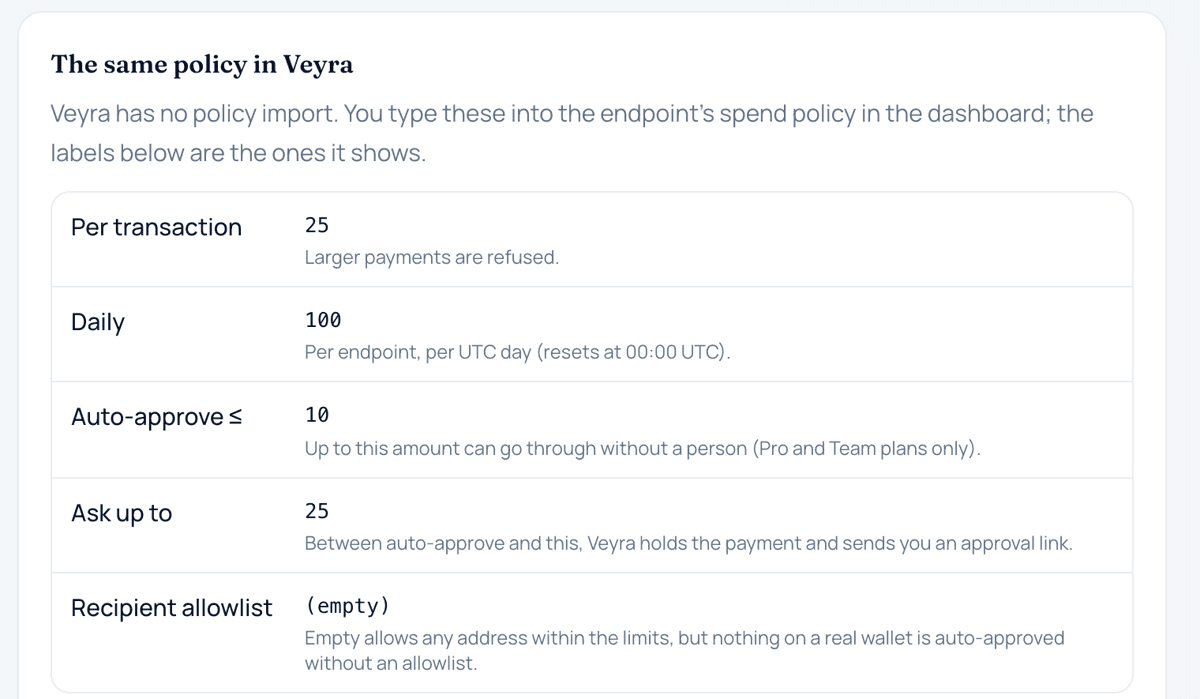
Veyra doesn't issue cards, hold card numbers, or implement the card networks' agent programmes or Stripe's tokens. It covers the last alternative: an agent connected to Veyra's MCP endpoint requests payments in USDC on Base from a wallet you already own, within per-payment, daily, auto-approve and ask limits and a recipient allowlist that Veyra enforces server-side. The agent never sees a key or seed phrase, and every decision is in the audit log. If what your agent needs to buy only takes cards, use a virtual card or token route instead; Veyra suits payees that accept USDC on Base.
Sources
- PCI Security Standards Council: PCI DSS
- OWASP GenAI Security Project: LLM01 Prompt Injection
- Stripe docs: Issuing
- Stripe docs: Issuing spending controls
- Stripe docs: Issuing real-time authorizations
- Stripe docs: Shared payment tokens
- Visa Developer: Visa Intelligent Commerce
- Mastercard: Mastercard unveils Agent Pay (press release, April 2025)
Terms on this page
- Shared Payment Token (SPT)A Shared Payment Token (SPT) is a Stripe credential that grants an agent or seller scoped use of a customer's payment method, such as a card, with usage and expiration limits.
- Recipient allowlistA recipient allowlist is a list of approved payees, such as wallet addresses, that a payment system checks before it lets an agent pay; payments to anyone not on the list are held or refused.
- Auto-approve limitAn auto-approve limit is the largest single payment an agent may make without a person approving it, within any other caps that apply.
This page explains how agent payments and the related technology work. It is not financial, investment, legal or tax advice. Protocols and provider features change; check the linked official sources before relying on a detail.