Glossary
What is an AP2 mandate?
AP2 mandates are signed credentials recording what a user authorised an agent to buy and pay. The two types, open vs closed, and who checks them.
An AP2 mandate is a cryptographically signed digital credential, defined by the Agent Payments Protocol, that records what a user authorised an AI agent to buy or pay for, so merchants and payment providers can verify it.
How does it work?
The current AP2 specification defines two mandates. A Checkout Mandate records the items and purchase details agreed between the agent and the merchant, and is verified by the merchant. A Payment Mandate authorises payment for a particular checkout and is verified by the credential provider, the network and the merchant's payment processor. Its fields include the payee, the amount in minor units, the payment instrument and a transaction ID that ties it to a hash of the checkout. Each mandate comes in two stages. An open mandate holds the constraints a user approved, such as allowed payees, an amount range, a budget or how often the agent may reuse it. A closed mandate holds one specific checkout and payment. The specification says verifiers always receive closed mandates. The two stages map to AP2's two modes. With a human present, the user sees and approves the closed checkout and payment directly. With no human present, the user approves an open mandate that names the agent's key, and the agent later signs closed mandates within those constraints. Google's September 2025 announcement described the same idea with different names, an Intent Mandate for the user's request and a Cart Mandate for the approved cart, so older articles may use those terms. Google describes the chain of signed mandates as an audit trail that can be checked if a payment is disputed.
In practice
If you build a shopping agent on AP2, your agent produces the mandate content and a trusted surface shows it to the user and collects their consent and signature. If you sell to AP2 agents, you verify the closed Checkout Mandate against the checkout you signed, and your payment processor verifies the Payment Mandate. The useful habit for anyone delegating is to read the open mandate's constraints as the real spending limit: a budget, an amount range and a list of allowed payees bound what the agent can later close. Check the specification version too, since the mandate names and schema identifiers have changed between releases.
What it does not mean
- A mandate is not a payment. It is signed evidence of what was authorised; money moves through the payment instrument it names.
- It isn't a direct debit mandate in the banking sense, though both record permission to take a payment.
- An open mandate doesn't let the agent spend anywhere. Its constraints, such as allowed payees and amount ranges, must be met, and constraints a verifier doesn't recognise must fail.
- Intent and Cart Mandate are the names from Google's 2025 announcement; the current specification uses Checkout and Payment Mandates.
Where does Veyra fit?
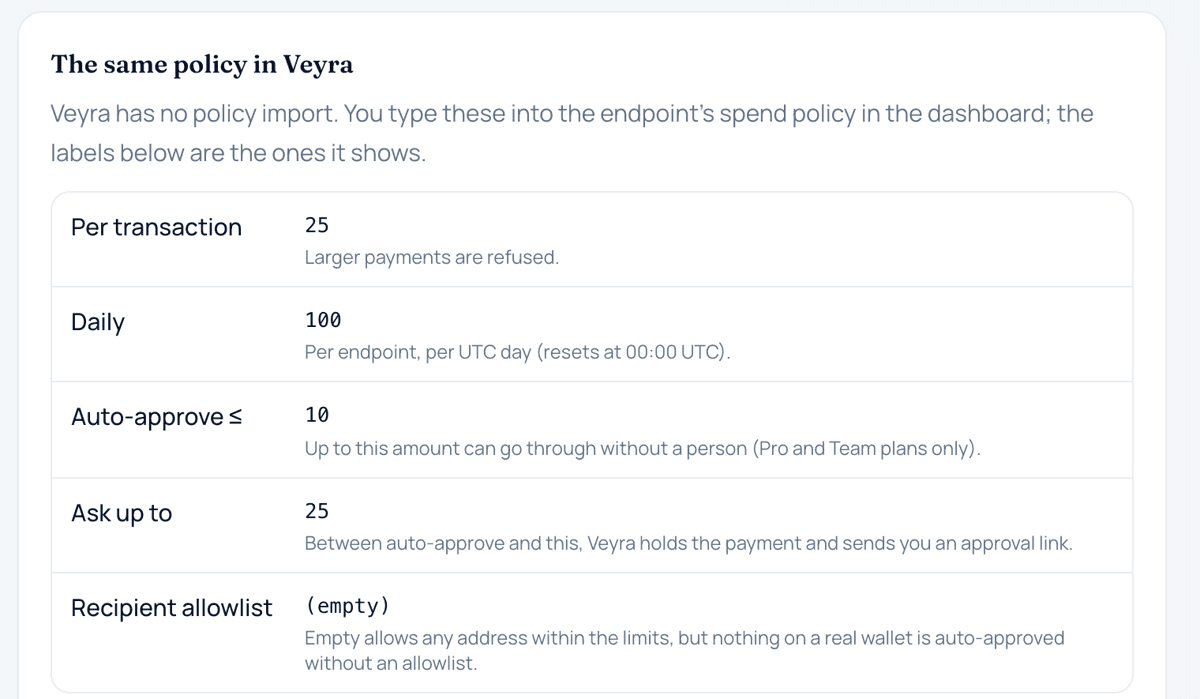
Veyra doesn't implement AP2 and doesn't create or verify mandates. It does something narrower: it enforces your own policy (per-payment, daily, auto-approve and ask limits, plus a recipient allowlist) on payments your agent requests over MCP, in USDC on Base, and keeps an audit log of each decision.
Sources
Guides that use this term
- What is AP2, the Agent Payments Protocol?AP2 records what a user let an AI agent buy as signed mandates. The roles, the two mandate types, human-present vs autonomous flows, and how it fits A2A, UCP.
- ACP vs AP2ACP (OpenAI and Stripe) runs checkout between an agent and a business; AP2 (Google) proves what the user authorised. Roles, tokens, mandates, status compared.
- x402 vs AP2x402 moves the money for an HTTP request; AP2 proves what the user authorised. How they differ, where they meet (the A2A x402 extension) and which you need.
- Human-in-the-loop approval for AI agent purchasesHow to make an agent wait for a person before larger payments: where the request goes, what the approver checks, and what happens if nobody answers.
This page explains how agent payments and the related technology work. It is not financial, investment, legal or tax advice. Protocols and provider features change; check the linked official sources before relying on a detail.