Comparisons
x402 vs AP2
x402 moves the money for an HTTP request; AP2 proves what the user authorised. How they differ, where they meet (the A2A x402 extension) and which you need.
x402 is a way to pay for an HTTP request with a signed stablecoin payment; AP2, published by Google, is a way to prove what a user authorised an agent to buy, using signed mandates, whatever the payment method. They work at different layers, and Google launched an A2A x402 extension so the two can be used together.
Why is this harder than it sounds?
Both get filed under 'agent payments', so they are often compared as rivals. But x402 answers 'how does this client pay this server for this request?', and AP2 answers 'how can a merchant, a card network or a bank tell that the user really wanted this purchase?'. An agent paying a cent for an API call mostly needs the first. An agent buying concert tickets with someone's card mostly needs the second. Mixing them up leads to signing mandates for micro-payments, or treating a payment signature as proof of the user's intent.
How do you do it?
- Who made it. x402 was created by Coinbase and moved to the x402 Foundation at the Linux Foundation in 2026. Google announced AP2 in September 2025 as an open protocol developed with payments and technology companies; the AP2 site now refers to a v0.2 release and a donation to the FIDO Alliance, where standardisation continues.
- What problem each solves. x402 lets a server state a price in a 402 response and a client pay it in the retry. AP2 records the user's instructions as verifiable digital credentials, so each party in a purchase has evidence of what was authorised; its stated principle is verifiable intent rather than inferred action.
- How authorisation works. In x402, the authorisation is the client's signature over one payment payload, which a facilitator verifies and settles. AP2 uses mandates: the current site describes a checkout mandate shared with the merchant and a payment mandate shared with the credential provider, networks and the merchant's processor, each open (constraints such as a budget) or closed (a specific, finalised authorisation). Google's launch post described the same idea as intent and cart mandates.
- Present or not present. Google's post covers both: a user approving a cart in real time, and a user signing rules up front, such as price limits and timing, so the agent can buy later when conditions are met. x402 has no notion of the user; it only sees a client that can sign.
- Payment rails. x402 is stablecoin-first, with schemes for EVM chains, Solana and others. The AP2 site says its initial version supports pull methods such as credit and debit cards, with push payments like real-time bank transfers and digital currencies on the roadmap.
- Where they meet. With Coinbase, the Ethereum Foundation, MetaMask and others, Google launched the A2A x402 extension for agent-based crypto payments. Its repository describes a merchant agent sending a payment-required message, the client returning a signed payment, and the merchant settling on-chain, with x402 as the underlying payment protocol.
- When to use which. Use x402 when a server wants to charge per request and clients can pay in stablecoins. Look at AP2 when the hard part is proving user authorisation to merchants and payment networks, especially for card purchases or purchases made while the user is away.
What it does not mean
- AP2 doesn't move money by itself. Mandates are evidence; a card network, bank or blockchain still settles the payment.
- An x402 signature isn't proof of the user's intent. It proves a key holder authorised a transfer, which may be an agent acting on bad instructions.
- Using both isn't redundant. The A2A x402 extension exists precisely to combine AP2-style agent commerce with x402 settlement.
Common questions
Does AP2 use x402?
Not by default. Google's announcement says it extended AP2's core constructs and launched the A2A x402 extension for crypto payments; the AP2 site lists an x402 scenario among its samples.
Is AP2 only for Google products?
Google describes AP2 as an open protocol, and the AP2 site says standardisation continues within FIDO Alliance working groups.
Which one stops an agent overspending?
Neither on its own. An AP2 open mandate can carry constraints such as a budget, but something holding the agent's credential still has to enforce limits.
Where does Veyra fit?
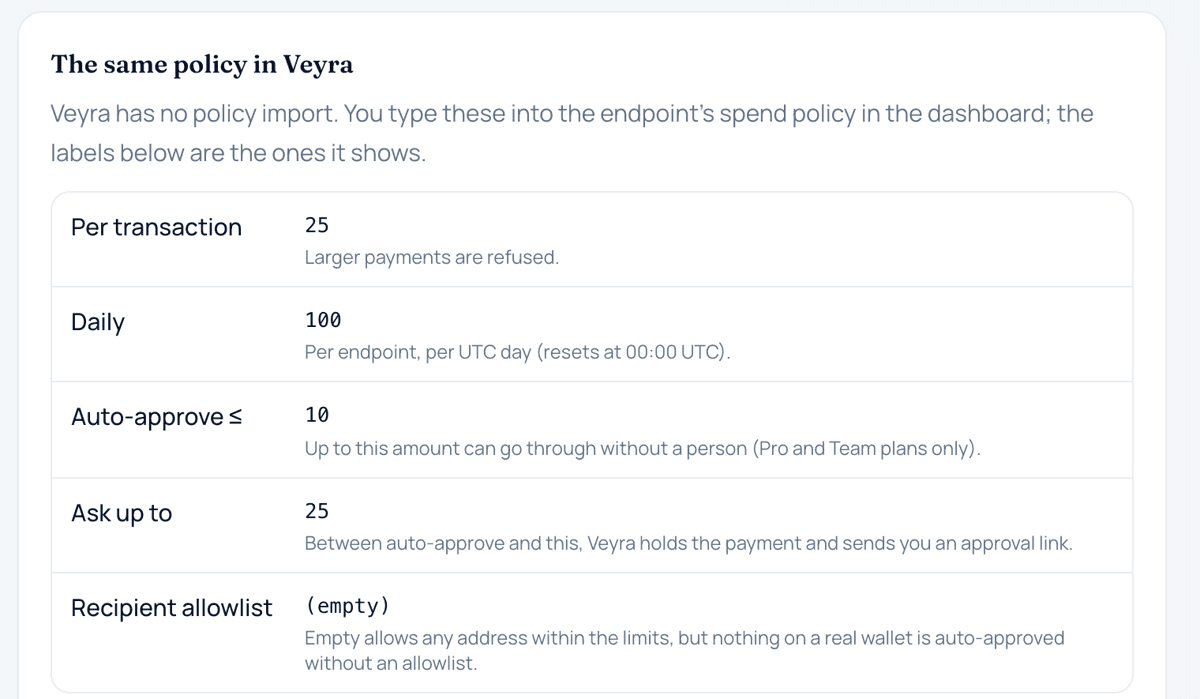
Veyra implements neither protocol. It covers a narrower version of both concerns for one payer: an agent asks Veyra's MCP endpoint to create_payment with a reason and an idempotency key, Veyra checks your limits and recipient allowlist, asks you to approve anything above your auto-approve limit, and logs each decision. That audit log is a record of your rules, not an AP2 mandate a merchant can verify. Payments go out in USDC on Base from your own wallet.
Sources
Terms on this page
- AP2 mandateAn AP2 mandate is a cryptographically signed digital credential, defined by the Agent Payments Protocol, that records what a user authorised an AI agent to buy or pay for, so merchants and payment providers can verify it.
- Agent2Agent (A2A) protocolThe Agent2Agent (A2A) protocol is an open standard, originated by Google and donated to the Linux Foundation, that lets AI agents built on different frameworks discover each other's capabilities and collaborate on tasks.
- HTTP 402 Payment Required402 Payment Required is an HTTP response status code that RFC 9110 lists as 'reserved for future use', meaning HTTP itself defines no standard behaviour for it.
- x402 facilitatorAn x402 facilitator is a service that verifies x402 payment payloads and settles them on-chain on behalf of a resource server, through /verify and /settle endpoints.
This page explains how agent payments and the related technology work. It is not financial, investment, legal or tax advice. Protocols and provider features change; check the linked official sources before relying on a detail.