Concepts and protocols
What is AP2, the Agent Payments Protocol?
AP2 records what a user let an AI agent buy as signed mandates. The roles, the two mandate types, human-present vs autonomous flows, and how it fits A2A, UCP.
AP2, the Agent Payments Protocol, is an open protocol created by Google for proving what a user authorised an AI agent to buy. It records that consent as cryptographically signed verifiable credentials called mandates, which the merchant, the credential provider and the payment processor each check before a payment goes ahead.
Why is this harder than it sounds?
When a person pays, the click is the evidence: they saw the basket and the total and approved it. When an agent pays, nobody downstream saw that happen. A merchant can't tell whether the user really wanted these items at this price, an issuer can't tell whether the agent was acting within its instructions, and in a dispute there is no record of what was agreed. AP2 doesn't move money; its specification describes it as a security feature that operates within a commerce protocol. Its job is to make the user's authorisation explicit, signed and checkable by each party, in the case where the user approves the exact checkout and in the harder case where they set rules in advance and the agent buys later.
How do you do it?
- The roles. The spec names a Shopping Agent that builds and executes the checkout, a Credential Provider that supplies payment credentials, a Merchant, a Merchant Payment Processor, and a Trusted Surface: a user interface that must not be agentic, used to get the user's informed consent. One company can play several roles.
- Two mandates, each open or closed. A Checkout Mandate goes to the merchant; a Payment Mandate goes to the credential provider, the network and the processor. An open mandate captures the user's constraints, such as a budget or allowed payment instruments. A closed mandate captures authorisation for one specific, finalised checkout and amount.
- Human present. The user sees the final checkout on the Trusted Surface and approves it and its payment directly. The merchant signs the checkout as a JWT, and the closed mandates are bound to it by hash, so the approval can't be reused for a different basket.
- Human not present. The user approves open mandates in advance. These include the agent's public key, and the Shopping Agent later creates and signs the closed mandates with its own key, within those constraints. Google's v0.2 announcement gives buying limited-run tickets the moment they go on sale as the kind of case this is for.
- Verification and receipts. The merchant verifies the Checkout Mandate; the credential provider, network and processor verify the Payment Mandate, which is bound to the same checkout. AP2 specifies SD-JWTs for both mandates, and each step returns a receipt, giving a chain of evidence for the transaction.
- Where it plugs in. AP2 is offered as an extension for the A2A protocol and is designed to be compatible with the Universal Commerce Protocol. Google's launch post also described it as usable as an extension of MCP, and announced an A2A x402 extension, built with Coinbase and others, for agent-based crypto payments.
What it does not mean
- AP2 doesn't move money. It authorises and records; settlement still happens on the card network, bank or chain underneath.
- It isn't a wallet or a dashboard spending limit. Open mandates carry constraints, but each party has to verify them.
- It isn't tied to Google Pay or to cards. The spec calls itself agnostic to the payment instrument, and the FAQ covers stablecoins as well as cards.
- The Intent Mandate and Cart Mandate you'll see in older articles come from the September 2025 launch post; the current spec on ap2-protocol.org is organised around Checkout and Payment Mandates.
Common questions
Who made AP2?
Google announced it on 16 September 2025 as an open protocol developed with payments and technology companies, released under Apache 2.0. In April 2026 Google said it was donating AP2 to the FIDO Alliance, where standardisation continues.
What happened to the Intent Mandate and Cart Mandate?
Those names come from the launch post. The current v0.2 specification describes Checkout and Payment Mandates, each in an open form for constraints and a closed form for a specific approval. Build against the version you are targeting; mandates carry a version in their vct claim.
Does AP2 work with stablecoins?
The FAQ describes AP2 as payment-agnostic, covering cards and stablecoins, and names Coinbase, the Ethereum Foundation and MetaMask among the organisations it worked with. Google's launch post introduced the A2A x402 extension for crypto payments.
How does AP2 relate to UCP?
UCP uses AP2 as an extension of its checkout: the platform submits a Checkout Mandate, which the business verifies, and a Payment Mandate, which the payment processor verifies, and the order completes only if both pass.
Where does Veyra fit?
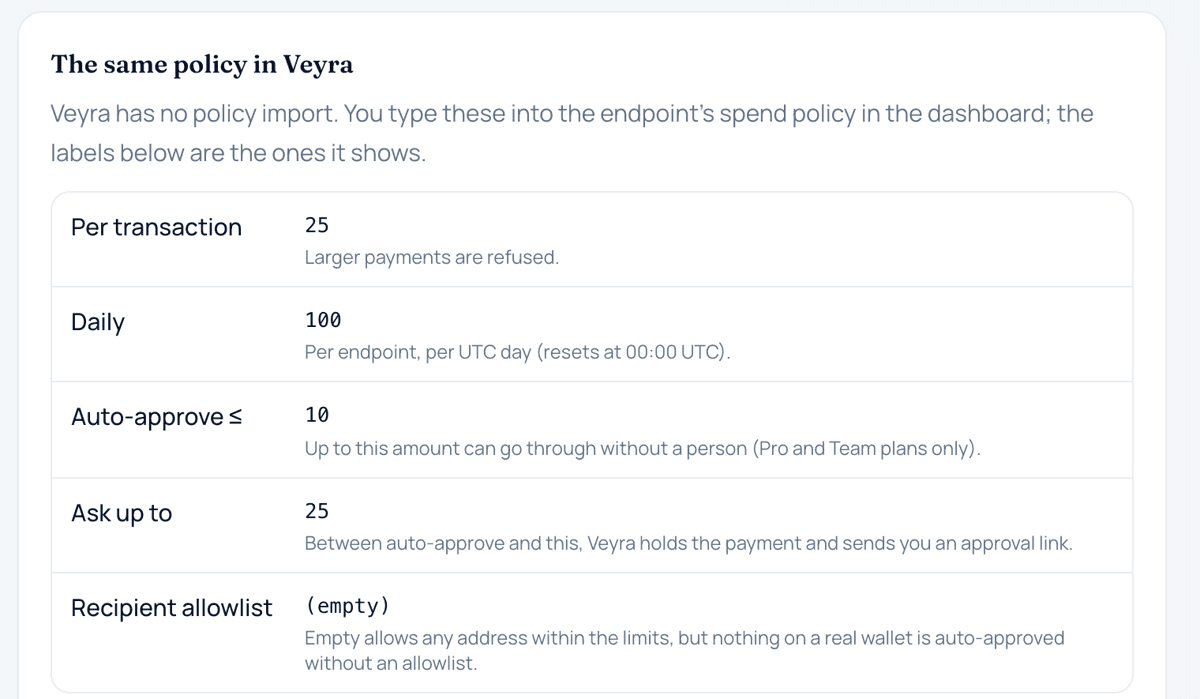
Veyra doesn't implement AP2 and doesn't produce signed mandates a merchant can verify. The idea is similar in one respect: you set the constraints in advance (per-payment, daily, auto-approve and ask limits, plus a recipient allowlist) and Veyra decides each create_payment request against them on its server, asking you to sign anything above your auto-approve limit. The evidence Veyra gives a payee is different: once a USDC payment on Base confirms, get_payment returns the on-chain tx_ref and an explorer link, and Veyra keeps an audit log of each decision for you.
Sources
Terms on this page
- AP2 mandateAn AP2 mandate is a cryptographically signed digital credential, defined by the Agent Payments Protocol, that records what a user authorised an AI agent to buy or pay for, so merchants and payment providers can verify it.
- Agent2Agent (A2A) protocolThe Agent2Agent (A2A) protocol is an open standard, originated by Google and donated to the Linux Foundation, that lets AI agents built on different frameworks discover each other's capabilities and collaborate on tasks.
- MCP serverAn MCP server is a service that offers tools, resources or prompts to AI applications using the Model Context Protocol, an open protocol built on JSON-RPC 2.0.
This page explains how agent payments and the related technology work. It is not financial, investment, legal or tax advice. Protocols and provider features change; check the linked official sources before relying on a detail.