Comparisons
Agentic commerce vs ecommerce
What changes when an AI agent shops instead of a person: discovery, checkout, payment credentials, proof of intent and fraud checks, with official examples.
In ecommerce a person browses a site, fills a basket and pays at a checkout; in agentic commerce an AI agent does some or all of that on the person's behalf, so the new questions are about delegation: what the agent was allowed to buy, how the payment credential is limited, and how the merchant knows the purchase is genuine.
Why is this harder than it sounds?
Online shops were designed around a person at a screen: product pages to persuade them, a checkout form to collect a card, a confirmation step, and fraud systems that look for human behaviour. An agent reads structured data rather than pages, has no card of its own, may act when the person isn't watching, and can look like a bot to a risk system because it is one. Most of what stays the same, such as fulfilment, returns and customer support, still sits with the merchant. What changes is everything between finding a product and getting paid.
How do you do it?
- Who finds the product. In ecommerce the shopper searches and browses. In agentic commerce the agent works from structured data: OpenAI's commerce docs, for example, ask businesses to submit product feeds for discovery in ChatGPT, and ACP's site describes checkouts that an agent can start with a business directly.
- Who checks out. Stripe announced Instant Checkout in ChatGPT on 29 September 2025, letting US ChatGPT users buy from US Etsy businesses inside the chat, built on the Agentic Commerce Protocol. OpenAI's current commerce docs also describe ChatGPT Wallet, where the customer approves a purchase in ChatGPT and pays through the business's existing website checkout. Check OpenAI's docs for what is available now.
- How the card is handled. In ecommerce the shopper types card details into the merchant's form. In Stripe's Instant Checkout description, Stripe issues a Shared Payment Token scoped to one merchant and basket total, and the card details aren't shared with the merchant. With ChatGPT Wallet, OpenAI's docs say the business receives a network token rather than the full card number, and the customer consents only to the specific transaction.
- How intent is proved. A click on 'Buy' used to be the evidence. Google's AP2 adds signed mandates instead, with examples in its announcement such as approving a cart of running shoes in real time, or signing rules up front to buy concert tickets the moment they go on sale.
- Fraud and risk checks. Risk systems built to stop bots can block agents. OpenAI's docs warn that ChatGPT's cloud browser may be flagged as a bot, and say OpenAI is rolling out user signals in the Forwarded HTTP header that merchants' risk systems can read.
- Machines buying from machines. Some agentic commerce has no shop at all: an agent paying an API per request. Stripe documents machine payments over MPP and x402, where a server returns a payment challenge and the agent presents a payment credential, with no account or checkout page.
- What stays with the merchant. ACP's site says businesses remain merchant of record, and OpenAI's ChatGPT Wallet docs say the business handles the order, fulfilment, customer support and fraud decisions. In Stripe's description of Instant Checkout, merchants also handle sales tax, fulfilment and returns.
What it does not mean
- Agentic commerce doesn't replace ecommerce sites. The examples above still end in a merchant's own systems; the agent changes who drives the steps.
- It doesn't mean the agent holds your card. The official approaches pass scoped tokens or network tokens, not raw card numbers.
- It isn't only shopping. Pay-per-request API payments between machines are part of it too.
Common questions
Do merchants need to rebuild their store for agents?
Not necessarily. OpenAI's ChatGPT Wallet docs say it works with existing checkout pages and payment forms, while ACP is an integration a business adds if it wants agents to check out directly.
Is agentic commerce live in the UK?
Availability varies by product and country. Stripe's Instant Checkout announcement was for US users and US Etsy businesses, so check each provider's docs for your country.
Who is liable if an agent buys the wrong thing?
The protocols address evidence rather than law: AP2's mandates aim to give each party a record of what was authorised. Liability depends on the merchant's terms, the payment network's rules and local law, and this page isn't legal advice.
Where does Veyra fit?
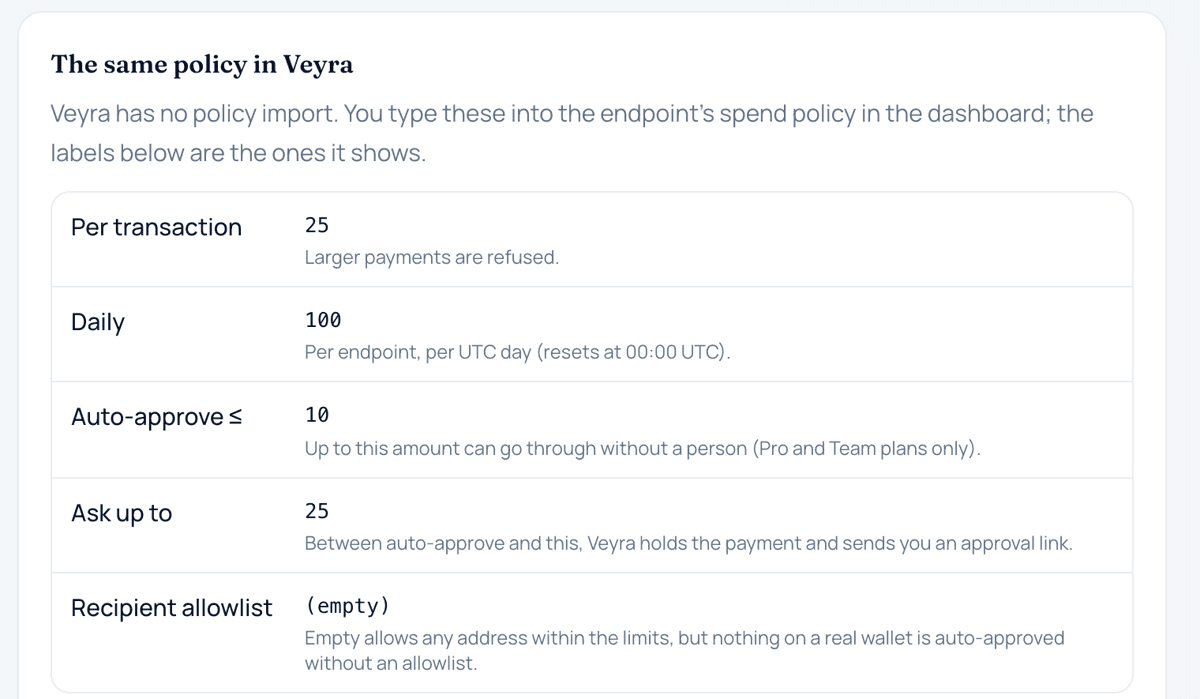
Veyra covers one part of agentic commerce: the payer's controls when an agent spends from a crypto wallet the owner already has. The agent gets an MCP endpoint, Veyra enforces per-payment, daily, auto-approve and ask limits and a recipient allowlist, and payments go out in USDC on Base, signed by the owner or, on paid plans, from a capped allowance. Veyra doesn't run checkouts, issue cards or tokens, implement ACP or AP2, or accept payments for merchants.
Sources
- OpenAI developer docs: Commerce
- OpenAI developer docs: Accept payments (ChatGPT Wallet)
- Stripe newsroom: Stripe powers Instant Checkout in ChatGPT and releases the Agentic Commerce Protocol
- Agentic Commerce Protocol
- Stripe docs: Shared payment tokens
- Google Cloud blog: Announcing the Agent Payments Protocol (AP2)
- Stripe docs: Machine payments (MPP and x402)
Terms on this page
- Merchant of record (MoR)The merchant of record is the business legally responsible for selling to the customer and processing their payment, including refunds, chargebacks, tax and payment compliance.
- Shared Payment Token (SPT)A Shared Payment Token (SPT) is a Stripe credential that grants an agent or seller scoped use of a customer's payment method, such as a card, with usage and expiration limits.
- AP2 mandateAn AP2 mandate is a cryptographically signed digital credential, defined by the Agent Payments Protocol, that records what a user authorised an AI agent to buy or pay for, so merchants and payment providers can verify it.
- Know Your Agent (KYA)Know Your Agent (KYA) is an emerging, not yet standardised term for verifying an AI agent's identity and linking it to the person or business it acts for, by analogy with Know Your Customer checks.
This page explains how agent payments and the related technology work. It is not financial, investment, legal or tax advice. Protocols and provider features change; check the linked official sources before relying on a detail.