Comparisons
ACP vs AP2
ACP (OpenAI and Stripe) runs checkout between an agent and a business; AP2 (Google) proves what the user authorised. Roles, tokens, mandates, status compared.
ACP, the Agentic Commerce Protocol from OpenAI and Stripe, standardises the checkout between an AI agent and a business, including passing a scoped payment token; AP2, the Agent Payments Protocol published by Google, standardises signed mandates that prove what the user authorised to merchants, credential providers and payment networks.
Why is this harder than it sounds?
Both are described as protocols for agents buying from merchants, both launched in September 2025, and both involve the user's card. So they are usually framed as competitors. Read the specs and they put the weight in different places. ACP is mostly about the conversation between the agent and the seller: the cart, the order, and how payment details reach the merchant without exposing the card. AP2 is mostly about evidence: a tamper-evident record of the user's instructions that the merchant and the payment side can check. A merchant may care about either, or both.
How do you do it?
- Who made it. ACP was developed by Stripe and OpenAI, is open source under Apache 2.0, and is jointly governed by OpenAI and Stripe as founding maintainers. AP2 was announced by Google in September 2025 with payments and technology companies; its site refers to a v0.2 release and a donation to the FIDO Alliance.
- What it covers. ACP's repository holds an Agentic Checkout API spec and a Delegate Payment spec, plus RFCs for capability negotiation, payment handlers and extensions, and it supports physical goods, digital goods, subscriptions and asynchronous purchases. AP2 defines a role-based architecture and mandates that pass between the user, the agent, the merchant, the credential provider, networks and the merchant's payment processor.
- How authorisation works. In ACP the buyer's credential reaches the business as a token. In Stripe's description of Instant Checkout, Stripe issues a Shared Payment Token scoped to a specific merchant and basket total, and the merchant can accept or decline the order. In AP2 the user's approval is a signed mandate: a checkout mandate for the merchant and a payment mandate for the payment side, each open (constraints) or closed (a final authorisation).
- The merchant's role. ACP's site says businesses keep their customer relationships as merchant of record and control what is sold and how orders are fulfilled. AP2 gives the merchant a checkout mandate to verify before accepting the purchase.
- Transport. ACP checkout can be exposed as a traditional API or over MCP. AP2 is offered as an extension for the A2A protocol and the Universal Commerce Protocol; Google's announcement also describes it as usable with MCP.
- Status. ACP's repository marks the spec as beta, with date-based versions; OpenAI was the first AI platform to implement it, in ChatGPT. AP2's initial version supports pull payment methods such as cards, with push payments and digital currencies on its roadmap.
- When to use which. A business that wants AI platforms to place orders with it looks at ACP. A party that needs portable proof of the user's intent, for disputes or for transactions made while the user is away, looks at AP2. Check what the agent platforms and processors you deal with actually support.
What it does not mean
- ACP isn't a payment network. The money still moves through a processor; ACP defines how the agent, business and provider exchange the order and the token.
- AP2 mandates aren't a checkout API. They are evidence attached to a purchase, not the cart and order messages themselves.
- Neither spec's documentation describes an integration with the other at the time of writing, so treat any combined set-up as your own design.
Common questions
Is ACP only for ChatGPT?
No. It is an open specification, and ACP's site says other AI platforms will be listed as they adopt it. OpenAI was the first to implement it.
Do I need Stripe to use ACP?
Stripe's announcement says businesses that don't process payments with Stripe can also adopt ACP. Stripe's Shared Payment Token was the first compatible payment method.
Does AP2 replace card network rules?
No. Google describes AP2 as working in concert with industry rules and standards, providing evidence for each transaction rather than replacing the networks.
Where does Veyra fit?
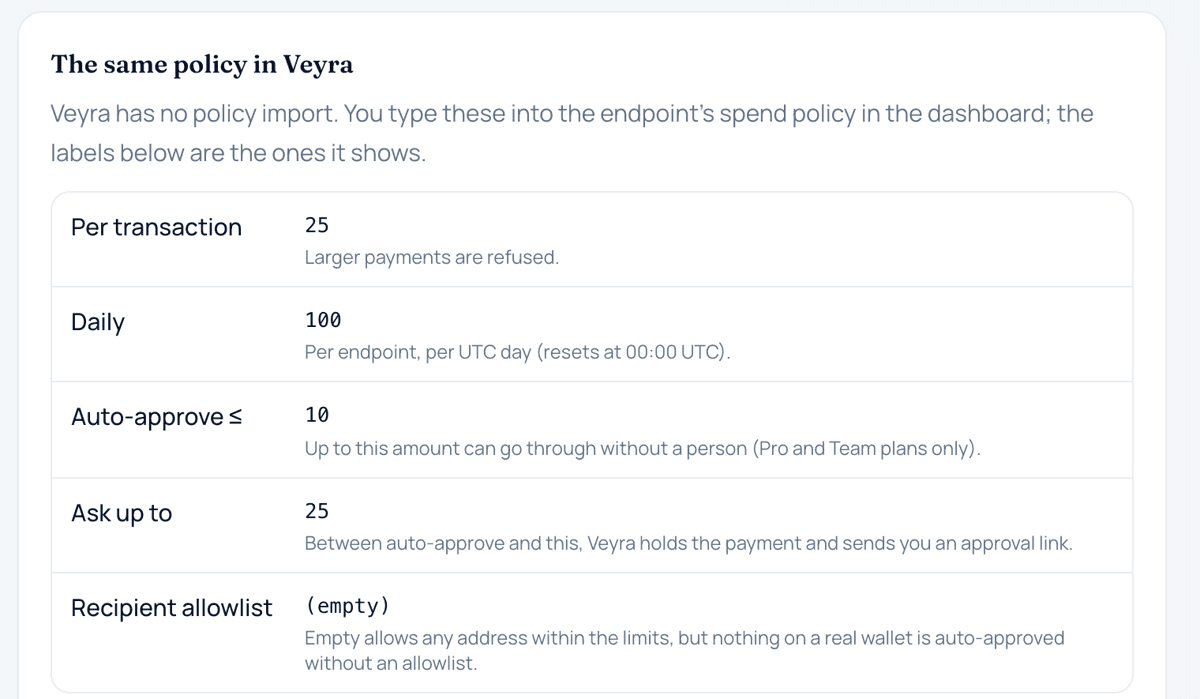
Veyra implements neither ACP nor AP2, doesn't issue cards or payment tokens, and doesn't accept payments for merchants. It sits on the payer's side: an agent calls create_payment on Veyra's MCP endpoint, and Veyra enforces your per-payment, daily, auto-approve and ask limits and recipient allowlist before paying USDC on Base from your own wallet. That covers payees who accept a USDC transfer, not merchants who only take an ACP checkout.
Sources
- Agentic Commerce Protocol
- Agentic Commerce Protocol specification (GitHub)
- Stripe newsroom: Stripe powers Instant Checkout in ChatGPT and releases the Agentic Commerce Protocol
- Stripe docs: Shared payment tokens
- AP2: Agent Payments Protocol
- Google Cloud blog: Announcing the Agent Payments Protocol (AP2)
- Agent2Agent (A2A) protocol
Terms on this page
- Shared Payment Token (SPT)A Shared Payment Token (SPT) is a Stripe credential that grants an agent or seller scoped use of a customer's payment method, such as a card, with usage and expiration limits.
- AP2 mandateAn AP2 mandate is a cryptographically signed digital credential, defined by the Agent Payments Protocol, that records what a user authorised an AI agent to buy or pay for, so merchants and payment providers can verify it.
- Merchant of record (MoR)The merchant of record is the business legally responsible for selling to the customer and processing their payment, including refunds, chargebacks, tax and payment compliance.
- Agent2Agent (A2A) protocolThe Agent2Agent (A2A) protocol is an open standard, originated by Google and donated to the Linux Foundation, that lets AI agents built on different frameworks discover each other's capabilities and collaborate on tasks.
This page explains how agent payments and the related technology work. It is not financial, investment, legal or tax advice. Protocols and provider features change; check the linked official sources before relying on a detail.