Concepts and protocols
What is the Universal Commerce Protocol (UCP)?
UCP lets AI agents discover a business's capabilities and run search, cart, checkout and orders with it. Who made it, how discovery works, and how payments fit.
The Universal Commerce Protocol (UCP) is an open-source standard, introduced by Google in January 2026 and co-developed with Shopify and other retailers, that lets AI agents and apps discover what a business supports and then run catalogue search, cart, checkout, identity linking and order tracking with it. The business stays merchant of record, and payments can be secured with AP2 mandates.
Why is this harder than it sounds?
Without a shared standard, every AI surface needs its own integration with every merchant, and every merchant has to rebuild checkout for each assistant. UCP replaces that with discovery and negotiation: a business publishes what it supports, an agent reads it and both settle on the capabilities and versions they have in common, with no hard-coded integration. It also covers the journey around the payment, from search to returns, not just the payment. The catch is scope: UCP is a framework of capabilities, extensions and transports, and payments go through separate payment handlers and AP2, so you need to read several parts of the spec to see how money actually moves.
How do you do it?
- The business publishes a profile. A machine-readable profile at /.well-known/ucp lists the business's services, capabilities, endpoints and payment configuration.
- Platform and business negotiate. The platform, such as an AI agent or app, identifies its own profile in the UCP-Agent header. The business works out the capabilities both support, such as dev.ucp.shopping.checkout, and picks the highest version they share. Extensions like discounts and fulfilment attach to a parent capability.
- Pick a transport. The same service can be offered over REST (OpenAPI), MCP, A2A or an embedded binding.
- Link the buyer's account. Identity linking uses OAuth 2.0 so the platform can act for a buyer without sharing their credentials.
- Pay through a payment handler. UCP separates instruments from payment handlers, which are specifications rather than companies: the instrument comes from a credential provider and the business charges through its own payment service provider. Stripe publishes a handler for card and Apple Pay credentials.
- Add AP2 for proof of consent. With the AP2 extension, the business signs the checkout state, the platform returns a Checkout Mandate and a Payment Mandate after the user consents, the business verifies the first and the processor the second, and the order is confirmed only if both pass.
What it does not mean
- UCP isn't a payment protocol by itself. It hands payment to handlers and, for verifiable consent, to AP2.
- It isn't Google-only. It is Apache 2.0 licensed with a Tech Council, and Stripe documents its own support and Tech Council membership.
- It isn't the same as ACP, although both let an agent check out with a business that stays merchant of record. They are separate specs with different maintainers.
- Not every vertical is finished. The lodging booking and food checkout extensions are marked draft on ucp.dev.
Common questions
Who created UCP?
Google introduced it on 11 January 2026, saying it was co-developed with industry partners including Shopify, Etsy, Wayfair, Target and Walmart. The spec lives at ucp.dev and on GitHub under the Universal-Commerce-Protocol organisation.
Where is UCP used?
Google's first reference implementation lets buyers check out from eligible businesses in AI Mode in Search and in Gemini; businesses need an active Merchant Center account and eligible products. Other platforms can implement the open spec.
Does UCP work with MCP?
Yes. MCP is one of the transports a UCP service can offer, alongside REST, A2A and an embedded binding.
How is UCP different from ACP?
Both standardise agent checkout with the business as merchant of record. UCP is broader, covering catalogue, identity linking and orders through negotiated capabilities, and uses AP2 for payment authorisation; ACP is maintained by OpenAI and Stripe and uses delegated payment tokens.
Where does Veyra fit?
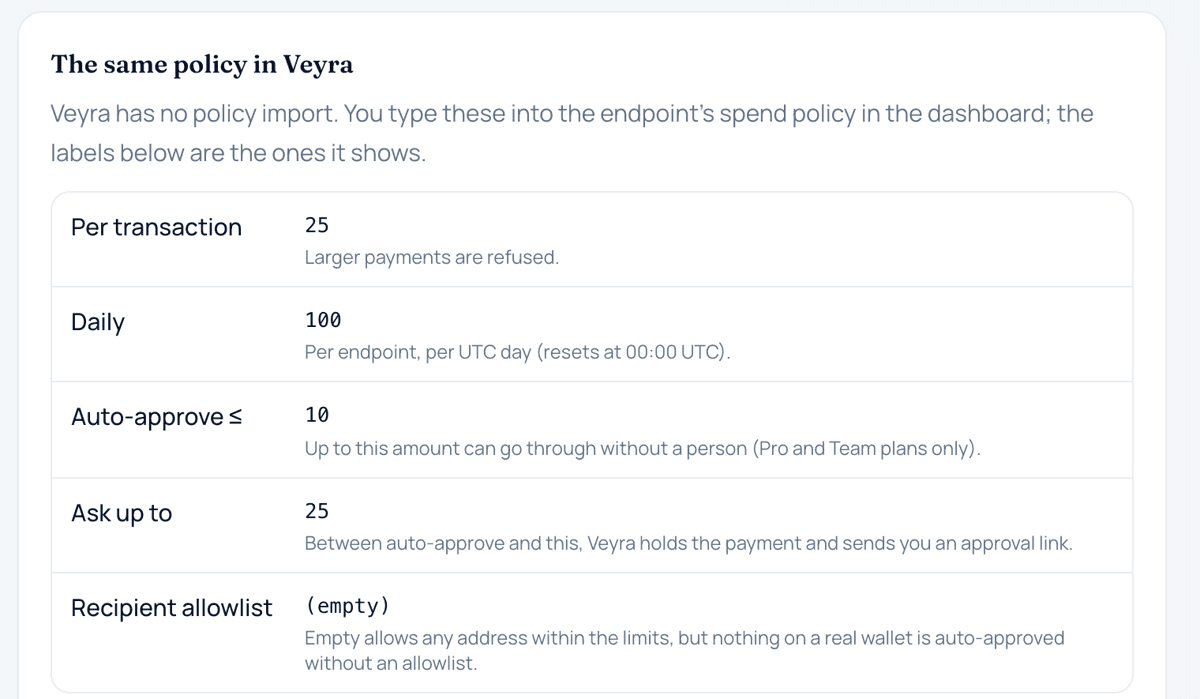
Veyra doesn't implement UCP and isn't a merchant platform. UCP describes how an agent buys from a business through its checkout and that business's payment provider, usually with cards or wallets; Veyra is a payer-side permission layer that lets an agent send USDC on Base from the owner's wallet to an allowlisted address, within per-payment, daily, auto-approve and ask limits. The two don't connect today.
Sources
Terms on this page
- Merchant of record (MoR)The merchant of record is the business legally responsible for selling to the customer and processing their payment, including refunds, chargebacks, tax and payment compliance.
- AP2 mandateAn AP2 mandate is a cryptographically signed digital credential, defined by the Agent Payments Protocol, that records what a user authorised an AI agent to buy or pay for, so merchants and payment providers can verify it.
- Agent2Agent (A2A) protocolThe Agent2Agent (A2A) protocol is an open standard, originated by Google and donated to the Linux Foundation, that lets AI agents built on different frameworks discover each other's capabilities and collaborate on tasks.
- MCP serverAn MCP server is a service that offers tools, resources or prompts to AI applications using the Model Context Protocol, an open protocol built on JSON-RPC 2.0.
This page explains how agent payments and the related technology work. It is not financial, investment, legal or tax advice. Protocols and provider features change; check the linked official sources before relying on a detail.